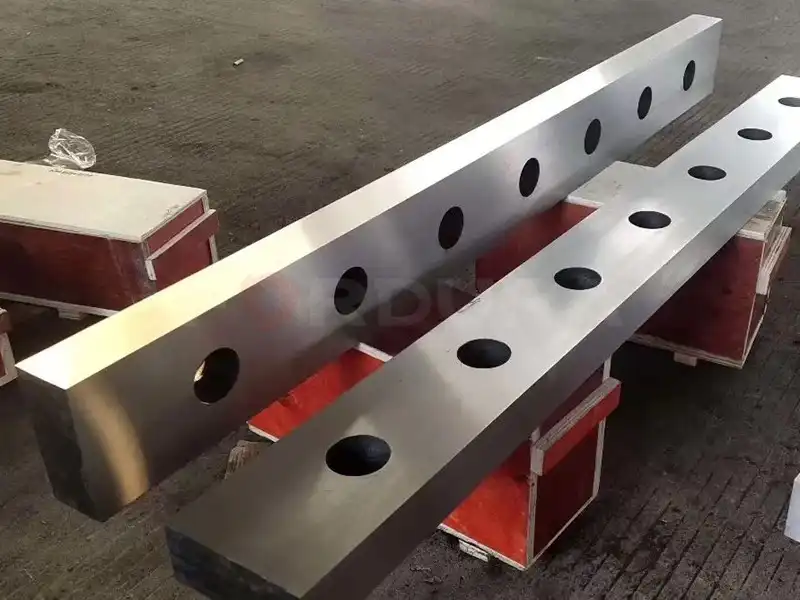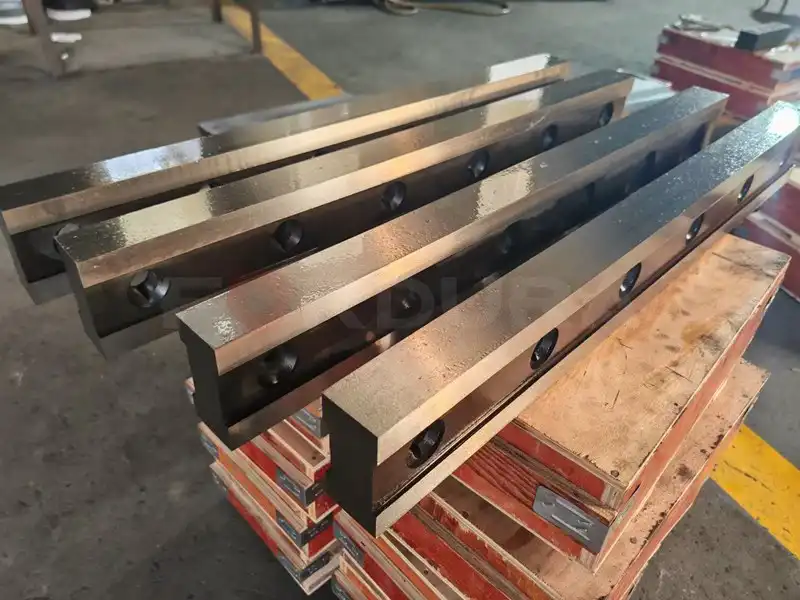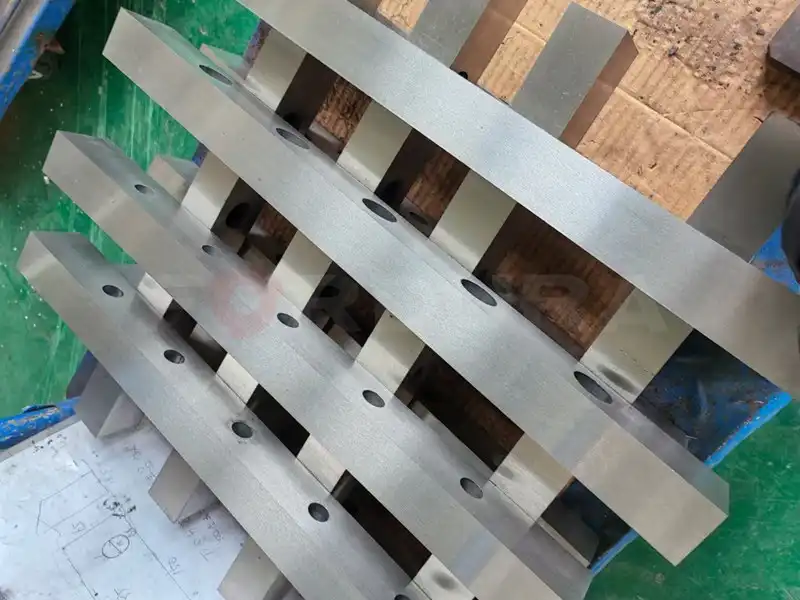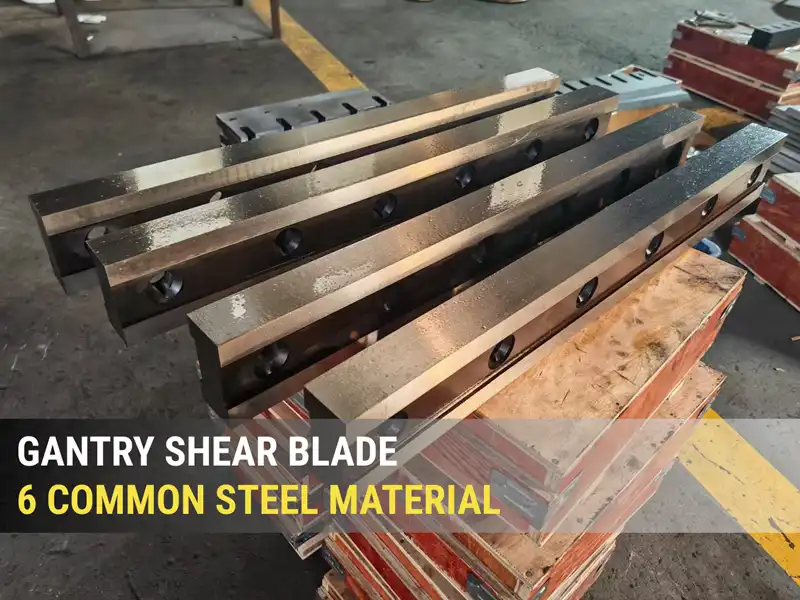
In scrap metal processing, gantry shear blade material is not a minor specification. It is one of the main factors that determines cutting efficiency, blade service life, maintenance frequency, and the real operating cost of the machine. Yet in many buying decisions, blade material is still treated too simply. Some buyers only compare price. Others assume the most expensive steel must always be the best option. In practice, both approaches can lead to unnecessary cost, unstable cutting performance, and avoidable downtime.
From a manufacturer’s perspective, blade material selection should always be tied to actual working conditions. A blade that performs well in a light-duty scrap yard may fail quickly in a high-volume operation processing thick structural steel. Likewise, a premium material may look impressive on paper but generate poor return on investment if the machine is only cutting relatively thin and soft feedstock. The right material is not the one with the highest price or the most alloy content. The right material is the one that matches the machine, the scrap type, the cutting load, and the customer’s production target.
At Fordura, we look at gantry shear blade material selection through a practical industrial lens. The real goal is not simply to buy steel. The goal is to achieve stable cutting, predictable blade life, lower cost per ton processed, and better machine profitability over time. That is why understanding the differences between common blade materials matters so much.
This guide explains six widely used gantry shear blade materials—55SiCr, M6V, H13, H13K, X45, and X45MoV—from the viewpoint of performance, applicable conditions, and cost-effectiveness. Instead of discussing materials in abstract terms, we focus on how they behave in real scrap cutting operations and how buyers should choose more intelligently.
Why Blade Material Matters More Than Most Buyers Think
A gantry shear blade works under repeated impact, compressive stress, friction, and localized heat buildup. As the machine cuts thicker or harder scrap, the blade edge must withstand not only wear, but also sudden shock loading and rising thermal stress. Under these conditions, material selection becomes one of the most important factors in blade performance.
The mistake many buyers make is treating blade material as a simple hardness issue. In actual operation, hardness alone is never enough. A blade that is hard but too brittle may chip or crack. A blade that is tough but not wear-resistant may lose its edge too quickly. A blade that performs well at room temperature may soften in continuous cutting if its hot-strength performance is inadequate. This is why a well-performing gantry shear blade material must offer balance: toughness, wear resistance, heat resistance, and structural stability all matter.
The blade also affects the entire machine system. As the edge becomes worn or unstable, cutting resistance rises. That means the machine needs more force to finish each stroke, which can increase power consumption, reduce throughput, create unstable cutting action, and accelerate wear on other components. In other words, blade material is not just a consumable decision. It is an operating efficiency decision.
Gantry Shear Blade Material Comparison at a Glance
Gantry Shear Blade Material Comparison Table
| Material | Relative Cost | Toughness | Wear Resistance | Heat Resistance | Best For | Main Limitation |
|---|---|---|---|---|---|---|
| 55SiCr | Low | Low | Low to Medium | Low | Light, thin scrap and low-frequency cutting | Easy to chip or crack under heavier impact |
| M6V | Low to Medium | Medium | Medium | Medium | Small to medium scrap yards processing regular light-to-medium scrap | Not ideal for extreme thickness or heavy shock load |
| H13 | Medium | Good | Good | Good to Excellent | Heavy scrap, thicker sections, and continuous industrial cutting | May not be enough for highly irregular or extreme impact conditions |
| H13K | Medium to High | Very Good | Good to Very Good | Good to Excellent | Mixed scrap streams, harder materials, and higher-impact cutting conditions | Higher cost than standard H13 |
| X45 | High | Excellent | Very Good | Very Good | Premium gantry shear applications requiring strong overall performance | Higher upfront cost than mid-range materials |
| X45MoV | Very High | Excellent | Excellent | Excellent | Extremely thick, hard, and high-impact scrap cutting applications | Highest cost; may be over-specified for many operations |
Quick Material Selection by Working Condition
| Working Condition | Recommended Material |
|---|
| Light, thin scrap with tight budget | 55SiCr or M6V |
| Regular light-to-medium scrap with better value requirement | M6V |
| Thick scrap and stable heavy-duty cutting | H13 |
| Mixed, irregular, or higher-impact scrap streams | H13K |
| High-end performance with better cost balance | X45 |
| Extreme-duty cutting where maximum performance is required | X45MoV |
These tables are useful for quick screening, but final material selection should never rely on a chart alone. In real gantry shear applications, material choice must also consider blade geometry, heat treatment, scrap grade, cutting thickness, machine tonnage, operating frequency, and the actual failure mode of the current blade.
55SiCr: The Lowest-Cost Entry-Level Option
55SiCr is often selected when budget is the main concern. It is a relatively low-cost steel and can be used in simple, light-duty cutting applications where the machine is not exposed to severe impact or continuous heavy production. For very small scrap operations or temporary low-cost replacement needs, it may appear attractive.
However, 55SiCr has clear performance limitations. Its toughness is relatively weak for demanding gantry shear applications, which means the blade edge is more likely to chip or crack when cutting conditions become unstable or impact load increases. In light scrap processing, this may not become critical immediately. But once the machine begins handling thicker material, harder inclusions, or more frequent cutting cycles, the weakness of the material becomes more obvious.
That is why 55SiCr should only be considered for light and thin scrap, low-frequency production, and low-demand operating conditions. It is not a strong long-term solution for customers who want stable blade life, predictable wear, and reduced downtime. In practice, what looks cheap at the time of purchase can become expensive when frequent blade damage and replacement interrupt production.
M6V: The Better Value Choice for Light to Medium Scrap
Compared with 55SiCr, M6V is usually a more practical low-cost option. It offers a noticeably better balance of toughness and service life while still remaining within a controlled budget range. For many small and medium scrap processors, this makes M6V the true value choice among entry-level and lower mid-range materials.
In real operating conditions, M6V is better suited for regular light-to-medium scrap cutting. It can handle conventional steel sections, moderate plate thickness, and routine yard production more reliably than 55SiCr. Its edge stability is better, and the risk of early chipping is lower when the application is moderately demanding but not yet severe enough to require premium tool steel.
This improvement matters because blade life is not only measured in hours or tons. Stability matters just as much. A blade that wears in a gradual and predictable way is easier to manage than a blade that fails unexpectedly from edge breakage. That is one reason why M6V often reduces both replacement frequency and operating uncertainty.
For customers who mainly process conventional scrap and want stronger cost-performance than the cheapest material can offer, M6V is often the most sensible starting point.
H13: The Standard Material Upgrade for Heavy-Duty Scrap Cutting
Once scrap cutting conditions become more demanding, H13 enters the conversation as a much more suitable gantry shear blade material. H13 is widely known as a hot work tool steel, and one of its most important advantages is its ability to maintain useful hardness and toughness under elevated temperature conditions.
This is especially valuable in gantry shear applications because continuous cutting creates heat at the blade edge. When thick steel, structural scrap, or higher cutting resistance materials are processed over longer production cycles, the blade edge can experience significant localized thermal buildup. Materials without strong hot-strength performance may soften under these conditions, which accelerates wear and reduces cutting stability. H13 performs much better in this environment.
For medium to large gantry shears handling thicker scrap and heavier-duty production, H13 is often considered a standard industrial-grade solution. It offers a good balance between wear resistance, toughness, and heat resistance, making it suitable for customers who need a serious performance step above lower-cost steels.
In practical terms, H13 is where many operations begin to see the difference between a blade that simply works and a blade that supports consistent industrial productivity.
H13K: A Better Option for Mixed Scrap and Higher Impact Loads
H13K is often chosen when standard H13 is good, but not quite enough. It can be seen as an enhanced option for more complex cutting environments where impact load, scrap inconsistency, and edge stress are higher. In real scrap processing, these conditions are common. Feedstock is not always uniform. Thickness changes, welded sections, mixed scrap grades, and hard spots all place irregular shock on the blade edge.
Under these conditions, the practical advantage of H13K becomes clear. It provides stronger resistance to chipping, cracking, and unstable edge failure, while still maintaining the hot-strength benefits expected from this performance level. This makes it particularly suitable for mixed scrap streams, harder materials, and cutting operations where downtime is expensive and blade reliability matters more than simply minimizing purchase price.
For customers dealing with demanding and unpredictable scrap, H13K is often one of the smartest upgrade choices. It is not only about longer blade life in theory. It is about better stability in real production.
X45: A Premium Choice with Better Cost-Performance Balance
X45 occupies an important position in the gantry shear blade market because it often delivers premium performance without the full cost burden of the highest-grade options. For many high-load applications, X45 provides the level of toughness, wear resistance, and working stability needed to support serious industrial cutting, while still offering a more balanced investment profile.
This is why X45 is often recommended for customers who want a major performance upgrade but still care about total cost efficiency. In many cases, it can cover demanding applications that are clearly beyond H13 or H13K territory, yet do not fully require the most extreme premium steel available.
The commercial value of X45 is that it often achieves the best compromise between performance and cost. It is strong enough for many high-end gantry shear applications, but it does not automatically push the buyer into the highest material cost bracket. For many scrap processors, that makes X45 the premium material that makes the most business sense.
X45MoV: The Top-Tier Material for Extreme Working Conditions
Among these six materials, X45MoV stands at the top in terms of performance potential. Often associated with the German steel designation 1.2746, this material is strengthened by alloying elements such as nickel, chromium, molybdenum, and vanadium. These elements work together to create a very powerful combination of impact resistance, wear resistance, toughness, and thermal stability.
This makes X45MoV especially suitable for extremely demanding gantry shear applications: very thick plate, oversized structural scrap, dismantled heavy equipment parts, and other high-resistance materials that place exceptional stress on the blade edge. In those conditions, lower-grade materials may wear too quickly, lose edge stability, or fail before they can produce acceptable economics.
The advantage of X45MoV is not simply that it is stronger on paper. Its value becomes visible when the cutting environment is harsh enough to justify it. In those cases, the blade can maintain performance longer and resist the severe combination of impact, wear, and heat that defeats lower-level materials.
However, this is also the most expensive option in the group. If the actual operating condition does not require its full performance range, the added investment may not generate proportional return. That is why X45MoV should be chosen carefully, based on application reality rather than the appeal of top-tier specifications.
How to Choose the Right Gantry Shear Blade Material
The most effective way to choose gantry shear blade material is to begin with the working condition, not with the material name. Buyers should first ask what the machine cuts every day, how thick the scrap is, how stable the feedstock is, how often the machine runs, and what kind of blade failure is currently occurring. A blade that mainly wears away needs a different solution from a blade that chips or cracks under impact.
For light and thin scrap with tight budget control, 55SiCr or M6V may be enough, though M6V is usually the better value option. For heavier and hotter cutting conditions, H13 is a much stronger industrial baseline. For mixed scrap, inconsistent feedstock, or higher impact loads, H13K offers better protection against unstable edge failure. For premium applications where performance matters but cost still needs to be justified, X45 often provides an excellent balance. For the most extreme cutting conditions, X45MoV becomes the logical top-tier choice.
This is how material selection should work in real industry: not by following the highest price, but by matching steel performance to operating demand.
Why the Most Expensive Material Is Not Always the Most Profitable
One of the most common misunderstandings in blade purchasing is the belief that the highest-grade material must always be the best investment. In reality, profitability depends on whether the material’s capability is actually used. If a customer’s application can already be handled effectively by X45, then moving to X45MoV may increase procurement cost more than it reduces downtime or blade change frequency.
The same principle applies on the low end. Choosing the cheapest material is not true cost control if short blade life leads to more downtime, more maintenance, lower cutting stability, and higher cost per processed ton. Purchase price alone is never the full economic picture.
The right target is optimized value. That means choosing a gantry shear blade material that is strong enough for the actual job, but not so over-specified that the customer pays for performance that the operation does not need.
Fordura’s Recommendation Logic: Match the Material to the Real Job
At Fordura, we do not treat blade material as an isolated issue. Material is only one part of blade performance. Blade geometry, heat treatment, machining accuracy, edge preparation, scrap type, and machine operating condition all affect the final result. Even the best steel can underperform if the blade is not engineered properly for the application.
That is why our recommendation process starts with real production details. We look at the machine model, scrap category, thickness range, cutting frequency, failure mode, and what the customer is actually trying to improve—longer blade life, better edge stability, fewer breakages, or lower total cost per ton.
From our experience as a gantry shear blade manufacturer, three practical conclusions often stand out. First, M6V is usually a more sensible entry-level choice than 55SiCr. Second, H13K is an excellent upgrade when standard H13 is not enough for mixed or high-impact work. Third, X45 often represents the most commercially balanced premium option for demanding gantry shear applications. X45MoV should be reserved for operations that truly need its top-level capability.