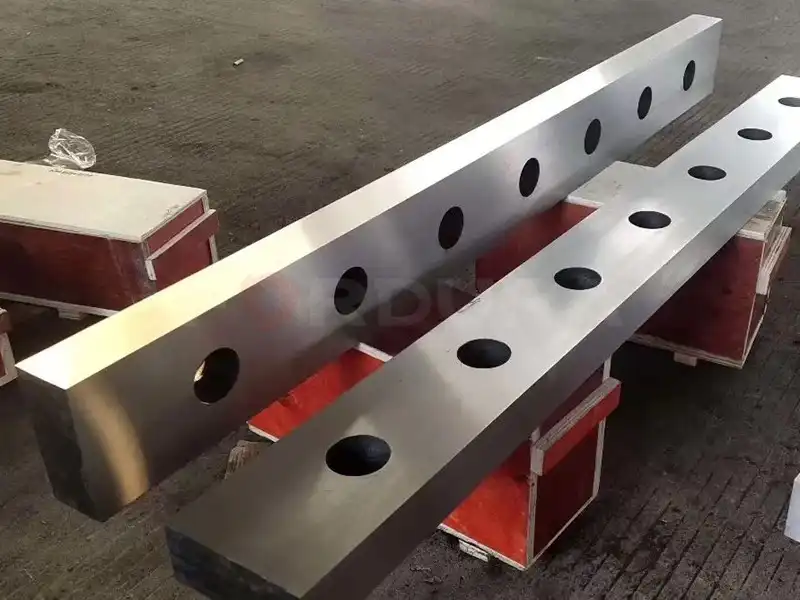
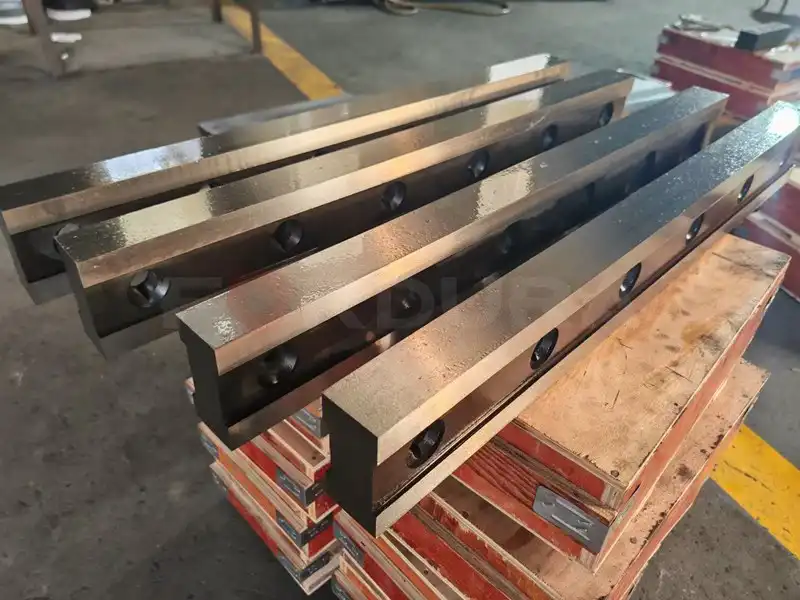
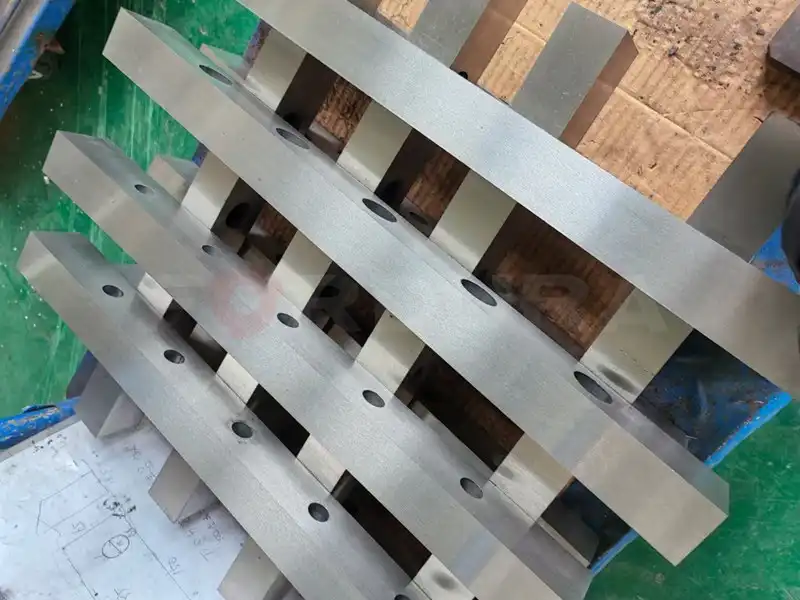
In heavy-duty scrap cutting, blade performance is often judged only by steel grade, heat treatment, or edge geometry. In practice, however, many premature blade failures do not begin at the cutting edge. They begin at the fastening system. A hydraulic shear blade can only perform as designed when clamping force remains stable under repeated impact, vibration, and shock loading. Once the bolt system loses preload, the blade is no longer working in a controlled condition. Micro-movement starts, local stress rises sharply, and the risk of chipping, cracking, and abnormal wear increases much faster than most operators expect.
At Fordura, we treat the bolt system as part of the blade system rather than a secondary accessory. For hydraulic shears processing thick scrap, rebar bundles, structural steel, and heavy plate, the difference between an ordinary commercial bolt and a properly engineered high-strength fastening solution is not marginal. It directly affects blade life, machine stability, energy consumption, maintenance intervals, and operator safety. Property class 12.9 fasteners are widely recognized as high-strength quenched-and-tempered alloy steel bolts, with minimum tensile strength around 1220 MPa under ISO 898-1 class requirements.
Why Bolt Failure Is a Hidden Cause of Blade Damage
When a hydraulic shear blade fails early, many users immediately suspect the blade material. Sometimes that is correct, but in many cases the root cause sits in the connection between blade and holder. The fastening system is responsible for maintaining clamping force while the blade is repeatedly exposed to impact loading and reverse stress. If clamp force drops, even slightly, the blade can shift microscopically during each cutting cycle. That movement may be invisible during inspection, but the consequences are severe: uneven contact, local overloading, unstable cutting force, and crack initiation near the mounting area.
This is why bolt quality matters far beyond simple “tightening.” In real production, the bolt is not merely holding the blade in place. It is preserving structural stability inside a high-energy cutting system. When low-grade or non-optimized bolts deform plastically, lose preload, or develop fatigue damage, the blade experiences a working condition it was never designed to tolerate. The result is often misdiagnosed as blade material failure when the real issue is fastening failure.
Common Problems with Standard Commercial Bolts
Many end users still replace blade bolts with standard commercial fasteners sourced from general hardware channels. This seems economical at first, but it introduces several risks in severe-duty metal cutting.
First, ordinary bolts often do not provide enough tensile strength or preload retention for repeated shock loading. Lower-grade fasteners can stretch, relax, or deform under heavy cutting conditions, which reduces clamping force and increases the chance of blade movement. Property class fastener data commonly show a large performance gap between lower classes and 12.9 class bolts in tensile and proof strength.
Second, poor thread quality or inadequate heat treatment can create stress concentration zones. Under cyclic loading, these become initiation points for fatigue cracks. High-strength fasteners also require proper processing because hardness and material condition strongly affect performance and reliability. ISO 898-1 based references for class 12.9 identify these bolts as quenched-and-tempered alloy steel products with very high proof and tensile properties.
Third, non-engineered bolts are rarely optimized for this specific application. Hydraulic shear blades are not static structural parts. They work in an environment of impact, vibration, edge reaction force, and thermal fluctuation. A bolt that is “good enough” for general industrial assembly may still be inadequate for scrap shear duty.
What Makes Fordura’s High-Strength Bolt System Different
Fordura uses high-strength blade bolts designed specifically for hydraulic shear duty, not generic fasteners selected only by size. Our fastening approach focuses on three engineering objectives: stable preload, improved fatigue resistance, and better stress distribution under real cutting conditions.
1. High Strength for Stable Clamping Force
Fordura’s standard high-strength bolt solution uses property class 12.9 fasteners. This strength level is associated with nominal tensile strength around 1200–1220 MPa and minimum proof strength around 970 MPa in ISO-based references, making it suitable for demanding clamping applications where preload stability matters. The key advantage is not only higher ultimate load capacity, but the ability to maintain stronger and more reliable blade clamping under repeated shock
2. Forged Structure for Better Mechanical Integrity
Compared with low-cost commercial fasteners, a forged high-strength bolt offers better grain flow continuity and more consistent internal structure. In demanding shear applications, that matters because the bolt is repeatedly exposed to load transfer, preload stress, and impact reaction. Better structural integrity means better resistance to deformation and fatigue accumulation over time.
3. Heat Treatment and Surface Strengthening
A high-strength bolt only performs well when metallurgy and process control are correct. Class 12.9 fasteners are typically quenched and tempered alloy steel products. Fordura’s fastening system is developed to support long-term dimensional stability, surface durability, and thread reliability in heavy-duty blade mounting conditions. The goal is to reduce the risk of internal crack initiation, preload loss, and thread-related stress concentration
4. Matched as Part of the Blade System
One of the most overlooked mistakes in the market is buying premium blades but treating bolts as an afterthought. Fordura supplies the blade and the fastening kit as a matched engineering package. This reduces compatibility problems between blade seat geometry, bolt size, washer support, and preload condition. For customers, this means fewer installation variables and more predictable service life.
Performance Comparison: Engineered High-Strength Bolts vs. Ordinary Commercial Bolts
Below is a simplified comparison based on the technical positioning of a high-strength scrap hydraulic shear blade fastening system versus common non-specialized bolts used in the field.
| Parameter | Fordura High-Strength Bolt System | Ordinary Commercial Bolts |
|---|---|---|
| Bolt class | 12.9 grade | Often non-specialized / lower class |
| Tensile strength | 1220 MPa class | Often 400–600 MPa range in low-grade market use |
| Hardness level | High-strength heat-treated condition | Lower hardness, less fatigue resistance |
| Preload retention | High and more stable | More likely to relax under impact |
| Fatigue resistance | Designed for repeated shock loads | Limited under severe cyclic service |
| Blade clamping stability | Strong | Inconsistent |
| Risk of blade movement | Low | Higher |
| Risk of secondary blade cracking | Lower | Higher |
| Suitability for heavy scrap cutting | Excellent | Poor to moderate |
Field Test Results in Heavy Scrap Cutting
In one heavy-duty comparison project at a scrap processing site in South China, a hydraulic shear running X45MoV blades was used to cut 20 mm manganese steel plate under the same production environment. The comparison showed a clear difference between an engineered high-strength fastening solution and ordinary bolts used as a substitute.
| Test Condition | Fordura High-Strength Bolt System | Ordinary Bolts |
|---|---|---|
| Blade service life | 287 hours | 89 hours |
| Failure mode | Stable wear progression | Edge chipping and abnormal failure |
| Energy per cutting cycle | 1.2 kWh | 1.8 kWh |
| Operating stability | High | Frequent interruption |
These results are important not because they prove a single bolt can “create” blade life on its own, but because they show how strongly fastening stability affects the cutting system. Once clamp force remains stable, the blade can work under the intended contact condition. When clamp force deteriorates, cutting becomes less stable, impact increases, and both blade damage and energy consumption rise.
How a Better Fastening System Reduces Total Operating Cost
The purchase price of a bolt is almost never the real cost driver. The real cost sits in downtime, unscheduled maintenance, blade damage, labor interruption, and hydraulic system stress.
When the fastening system is properly engineered, customers typically gain value in four areas:
1. Longer Blade Life
Stable clamping reduces vibration-induced damage, mounting stress concentration, and abnormal cutting impact. The blade wears more predictably and reaches a longer usable life before replacement.
2. Less Downtime
Fewer bolt-related failures mean fewer emergency stoppages. For high-throughput yards, this may be more valuable than the hardware cost difference itself.
3. Lower Energy Consumption
A stable cutting system transfers force more efficiently. In unstable conditions, additional energy is consumed by shock, movement, and inconsistent blade engagement rather than effective cutting.
4. Better Safety Margin
Fastener failure in heavy scrap cutting is not only a maintenance problem. It is also a safety risk. A properly specified fastening system helps reduce the chance of blade displacement, broken hardware, and secondary equipment damage.
Fast Inspection Checklist for Hydraulic Shear Blade Bolt Systems
Use this checklist during routine maintenance to identify early fastening-related problems before they become blade failures.
Quick Checklist
| Symptom | Likely Cause | Recommended Action |
|---|---|---|
| Repeated edge chipping near mounting area | Preload loss or blade micro-movement | Check bolt condition, seating surface, and torque procedure |
| Uneven wear between blade positions | Inconsistent clamping force | Inspect bolt stretch, washer support, and holder flatness |
| Bolts loosening too frequently | Inadequate bolt grade or locking method | Upgrade to engineered high-strength bolt kit |
| Cracks starting near bolt holes | Stress concentration or unstable contact | Review bolt quality, contact fit, and blade seating |
| Higher power consumption during cutting | Blade instability or poor force transfer | Inspect full blade and fastening system together |
| Unexpected blade breakage under heavy load | Fatigue damage or shock overload | Replace with matched blade + bolt package |
Why Buying Blades and Bolts Together Makes More Sense
In industrial cutting systems, the blade, holder, washer, and bolt should never be treated as unrelated parts. When they are selected separately, responsibility becomes fragmented and troubleshooting becomes slower. One supplier blames blade material. Another blames installation. Another blames operating conditions. The customer loses time.
Fordura’s approach is to engineer the cutting package as a complete system. That means the blade material, geometry, hardness range, fastening strength, and mounting compatibility are considered together. This is especially valuable for customers processing difficult scrap streams such as thick plate, mixed heavy scrap, rebar bundles, and high-impact ferrous materials. When the entire assembly is designed to work together, performance becomes more predictable and operating cost becomes easier to control.