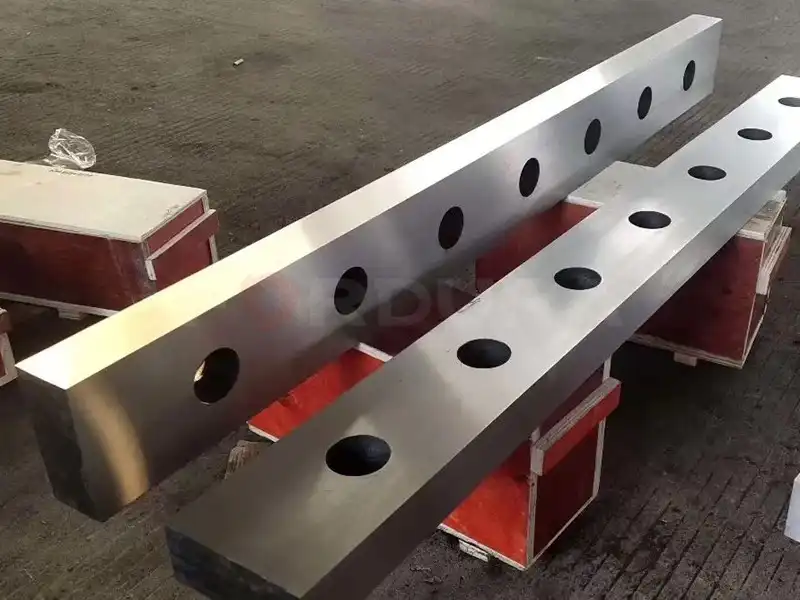
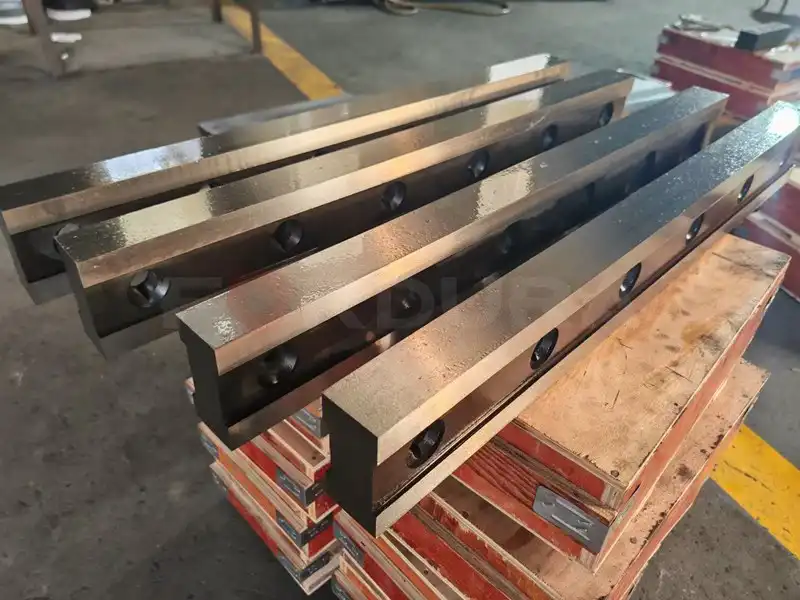
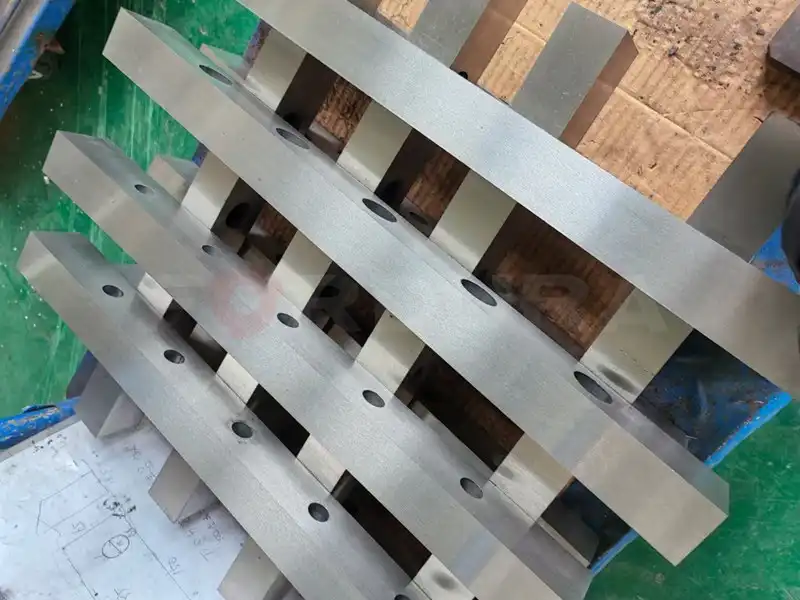
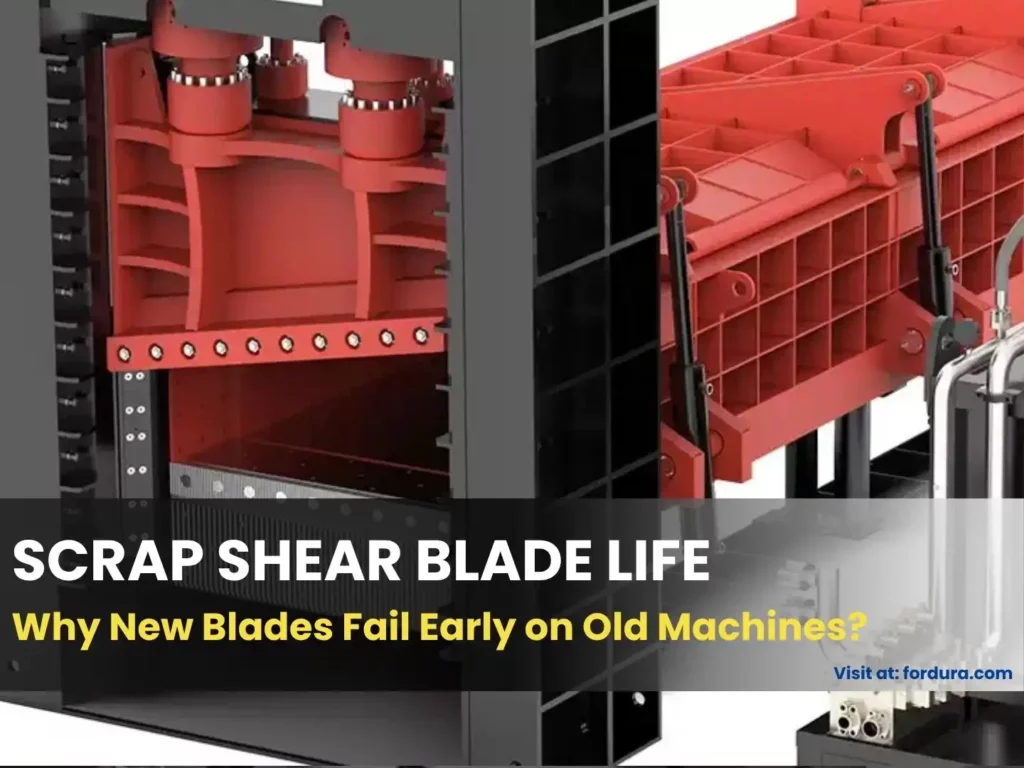
In heavy scrap processing, blade material is never a minor specification. It directly affects cutting stability, blade life, regrind frequency, maintenance rhythm, downtime exposure, and total cost per ton processed. That is why the comparison between H13 and H13K matters so much. Whether the equipment is described as a gantry shear machine, a hydraulic gantry shear, or a scrap guillotine machine, the same material-selection logic still applies: the wrong blade material may still cut, but it will usually cost more over time.
Many buyers ask a simple question: which one is better? In practice, that is the wrong starting point. The right question is which one is more suitable for the actual cutting environment. A scrap yard processing relatively standard heavy scrap with stable maintenance intervals does not need the same material strategy as a line cutting denser mixed scrap, harder alloy contamination, and higher shock loads under strict uptime pressure. That is true whether the machine is called a gantry shear or referred to by another common industry name, the scrap guillotine machine.
This is where H13 and H13K should be compared not as labels, but as engineering and procurement choices. H13 remains one of the most proven and commercially efficient hot-work blade materials in heavy-duty use. H13K, by contrast, should be understood as a reinforced H13-based route designed for harsher duty, especially where impact, temperature, wear, and interruption cost all rise together.
For engineers, the decision is about performance reserve. For buyers, it is about economic return. For plant managers, it is about production continuity. The material that wins is not the one that sounds more premium. It is the one that delivers the best cutting economics under the real operating window of the machine.
Why This Material Choice Has a Bigger Cost Impact Than Many Buyers Expect
In heavy scrap cutting, the most expensive mistake is often not buying an expensive blade. It is buying a blade that looks economical but creates hidden cost later. That hidden cost shows up as shorter edge retention, more frequent regrinding, unstable cutting, rising maintenance intervention, and unplanned blade changes that disrupt the whole process around the shear.
A blade material can appear acceptable in the short term and still be the wrong commercial choice. Many blades do not fail in a dramatic way. They fail gradually through a loss of edge stability and service consistency. Once that happens, the plant starts paying in other ways: more operator attention, more production interruptions, more maintenance labor, and less predictable throughput.
That is why H13 vs H13K is not just a metallurgical discussion. It is a business decision with direct consequences for uptime, blade consumption, and cost control across any gantry shear machine or scrap guillotine machine running under heavy-duty scrap conditions.
H13 vs H13K: Executive Comparison Table
Quick selection logic:
- Choose H13 when your operation needs a reliable and commercially balanced blade material for mainstream heavy-duty scrap cutting.
- Choose H13K when your operation is clearly more severe, and the cost of edge instability, frequent regrinding, or unplanned blade changes is already becoming expensive.
- Do not compare blade price to blade price alone. Compare material fit to output stability, maintenance rhythm, and cost per ton processed.
| Comparison Factor | H13 | H13K |
|---|---|---|
| Material positioning | Mature, balanced hot-work blade material | Reinforced H13-based upgrade for harsher duty |
| Overall strength profile | Strong all-round performance | Higher performance reserve at the extreme end |
| Toughness under impact | Good | Better |
| Hot hardness retention | Good | Better |
| Wear resistance | Good | Better in more severe duty |
| Thermal fatigue stability | Excellent | More stable under aggressive cycles |
| Cost profile | More economical upfront | Higher initial cost |
| Best-fit duty | Standard high-intensity production | Extreme high-impact, high-heat, high-wear production |
| Commercial logic | Better balance for mainstream duty | Better return when downtime is expensive |
What Makes Standard H13 So Valuable in Gantry Shear and Scrap Guillotine Blade Applications
H13 should not be misunderstood as an ordinary or low-tier option. It remains a benchmark hot-work tool steel because its overall balance is already extremely strong. It combines thermal fatigue resistance, toughness, and wear resistance in a way that makes it highly suitable for long-duration, high-load cutting service. That is exactly why H13 has remained a dependable solution across demanding industrial blade applications.
For gantry shear blades and scrap guillotine machine blades, that balance matters. During continuous cutting, the blade edge is exposed not only to mechanical load, but also to temperature cycling, local stress concentration, interrupted contact, and impact variation caused by inconsistent scrap geometry. H13 performs well because it does not rely on one extreme property. Instead, it delivers a stable combination of properties that allows the blade to keep working reliably across a broad operating range.
This is also why H13 often represents the best value choice for many plants. If the line is processing relatively standard heavy scrap and the target is to achieve a strong balance between cutting reliability, useful blade life, and purchasing cost, H13 is often more than sufficient. It is not the material buyers choose only when they want to spend less. It is the material many experienced teams choose because it is mature, predictable, and commercially efficient.
Why H13K Exists as an Upgrade Path
H13K should not be treated as a completely unrelated steel family. It is more accurate to understand it as an upgraded route built on the H13 hot-work framework. The main logic is not to replace everything H13 already does well. The logic is to keep that proven base, then add more performance reserve where harsher duty requires it.
This matters because many shear lines do not fail under normal cutting conditions. They fail economically when the process becomes more aggressive than the original blade material was designed to tolerate comfortably. Harder mixed scrap, alloy-rich contamination, more violent shock loading, longer cutting cycles between maintenance stops, and stronger uptime requirements all narrow the operating margin. Once that happens, a standard balanced material may still function, but it may no longer deliver the best total business result.
That is where H13K becomes relevant. It is selected not because every plant needs maximum material intensity, but because some plants face operating conditions where more toughness, more hot-strength retention, and more wear stability can reduce more expensive downstream problems. This is especially true in heavy-duty hydraulic gantry shear systems and scrap guillotine machines working under severe production pressure.
Chemical Difference Snapshot: H13 vs H13K
| Element | Standard H13 | H13K | Difference | Why It Matters in Shear Blade Service |
|---|---|---|---|---|
| Si | 0.80–1.20 | 0.80–1.20 | Same | Supports strength and hot-work balance, but not a key differentiator in this comparison. |
| Mn | 0.20–0.50 | 0.20–0.50 | Same | Helps hardenability and processing balance, but does not define the upgrade logic. |
| P | ≤0.030 | ≤0.030 | Same | A control element rather than a performance upgrade point. |
| S | ≤0.030 | ≤0.030 | Same | Also a control element; lower sulfur supports steel cleanliness and stability. |
| Cr | 4.75–5.50 | 4.75–5.50 | Same | A core hot-work alloy element in both grades, supporting hardenability, wear resistance, and heat resistance. |
| Mo | 1.10–1.75 | 1.10–1.75 | Same | Helps maintain strength and temper resistance at elevated operating temperature. |
| V | 0.80–1.20 | 0.80–1.20 | Same | Supports carbide formation, wear behavior, and edge stability. |
| Ni | — | 0.2–0.4 | Added | Improves toughness and impact resistance, giving H13K more safety margin under shock-heavy cutting. |
| W | — | 0.8–1.2 | Added | Improves hot hardness, wear resistance, and thermal stability in severe-duty service. |
What the Chemistry Difference Really Means in Production
The chemical difference between H13 and H13K is important not because every element changes, but because the right elements change. The shared Cr-Mo-V backbone means both materials belong to the same broad hot-work logic. Both are designed to perform in high-load conditions where temperature, stress, and wear interact continuously. In other words, H13K does not abandon the H13 foundation. It builds on it.
The real differentiation starts with nickel and tungsten. Nickel strengthens the material from the toughness side. In heavy scrap cutting, that matters whenever the blade is exposed to repeated shock, interrupted cuts, edge impact, or difficult scrap geometry that creates local overload. Better toughness means the blade can absorb more punishment before chipping, corner failure, or fracture risk becomes critical.
Tungsten changes the equation from the hot-strength and wear side. As the blade edge works through sustained duty, it does not experience simple room-temperature wear. It experiences load, friction, heat buildup, and repeated stress cycling. Tungsten helps the material hold hardness and wear resistance deeper into that severe service window. In practical terms, that means H13K is better positioned to keep edge performance more stable when cutting conditions become hotter, harder, and more punishing.
This is why H13K should not be marketed as a vague premium option. Its value is specific. Nickel adds more internal toughness reserve. Tungsten adds more external hardness, wear resistance, and thermal stability. Together, they create a stronger margin for extreme-duty gantry shear machine and scrap guillotine machine applications.
Tested H13K Sample Snapshot
| Element | Tested H13K Sample | Standard H13 Reference | Interpretation |
|---|---|---|---|
| Si | 0.9628 | 0.80–1.20 | Within H13 baseline range |
| Mn | 0.2484 | 0.20–0.50 | Within H13 baseline range |
| P | 0.0198 | ≤0.030 | Normal |
| S | 0.00293 | ≤0.030 | Very low, favorable for cleanliness |
| Cr | 5.0602 | 4.75–5.50 | Within H13 baseline range |
| Mo | 1.3076 | 1.10–1.75 | Within H13 baseline range |
| V | 0.8610 | 0.80–1.20 | Within H13 baseline range |
| Ni | 0.22 | — | Clear differentiator |
| W | 1.0832 | — | Clear differentiator |
This sample makes the comparison more concrete. Most of the H13K chemistry still sits inside the established H13-type framework. The major divergence is not a wholesale redesign of the steel. The major divergence is the presence of nickel and tungsten as the meaningful upgrade points. That is exactly why H13K should be understood as a reinforced H13 route rather than a completely separate material philosophy.
Performance Comparison: Where the Difference Shows Up in Real Use
| Performance Area | H13 | H13K |
|---|---|---|
| Core behavior | Balanced and dependable | Reinforced for extreme-duty stability |
| Toughness / impact resistance | Good | Excellent, supported by Ni addition |
| Hot hardness / wear resistance | High | Significantly improved, supported by W addition |
| Thermal fatigue resistance | Excellent | More stable under harsher thermal-mechanical cycling |
| Standard continuous cutting | Strong fit | Also capable, but may be more than necessary |
| Very hard and mixed scrap | Can approach its limit faster | Better suited |
| Long uninterrupted production demand | Reliable | Better when uptime penalties are high |
| Procurement logic | Best value for many mainstream lines | Better when stability is worth more than initial cost |
Where Standard H13 Is Usually the Better Choice
H13 is usually the better choice when the cutting operation is intense but still relatively predictable. This includes lines processing mainstream heavy scrap, plants with stable maintenance discipline, and operations where the goal is to achieve a strong balance between performance, blade life, and purchase cost. In these environments, H13 gives buyers what they actually need: reliability without unnecessary over-specification.
That is important because overbuying material can be just as inefficient as underbuying it. If the plant does not routinely face severe alloy contamination, violent shock loading, rapid edge collapse, or extreme uptime pressure, the additional cost of a reinforced material may not generate proportional value. In those cases, H13 often remains the smartest business decision because it delivers proven service without pushing blade cost beyond what the process requires.
This logic applies to both conventional gantry shear machine blade replacement and scrap guillotine machine blade purchasing, where the target is not maximum alloy complexity, but the best match between blade material and real operating duty.
Where H13K Starts to Make More Sense
H13K begins to make more sense when the operation is no longer forgiving. This usually happens when the shear is cutting harder and more complex scrap mixes, when impact events are more frequent and severe, when production runs are longer and hotter, or when the cost of unplanned downtime is high enough that a stronger material margin creates a measurable financial return.
In these conditions, a standard balanced material may still cut, but it may lose edge stability sooner, require more frequent intervention, or expose the operation to more unpredictable wear behavior. H13K creates value by pushing those limits outward. It helps reduce the risk that the blade becomes the weak link in a process where continuity matters more than simple unit price.
This is especially relevant in heavy-duty hydraulic gantry shear operations and scrap guillotine machine lines where every blade change affects more than maintenance labor. It may also affect crane rhythm, material flow, staffing coordination, downstream scheduling, and delivery commitments. Once those costs are included, the higher initial cost of H13K can be easier to justify.
Cost per Blade vs Cost per Ton Processed
This is the point where procurement decisions become either strategic or short-sighted.
A cheaper blade can still be the more expensive choice if it drives more regrinding, more stoppages, and more instability. A more expensive blade can still be the wrong choice if the line never uses the extra performance it is paying for. The correct comparison is not blade price versus blade price. It is total blade-related cost versus total processed output.
| Cost Area | If Material Is Under-Matched | If Material Is Correctly Matched |
|---|---|---|
| Blade life | Shorter and less predictable | Longer and more stable |
| Regrind interval | Shorter | Longer |
| Changeover frequency | Higher | Lower |
| Cutting consistency | More variable | More stable |
| Downtime exposure | Higher | Lower |
| Cost per ton processed | Usually worse than expected | Usually better over time |
That is why H13 often wins in standard-duty environments and H13K often wins in severe-duty environments. The winner is the material that reduces the most expensive form of waste in your plant.
Symptom / Cause / Better Direction
| Production Symptom | Likely Material-Related Cause | Better Direction |
|---|---|---|
| Edge wear becomes too fast | Material reserve is too low for the duty level | Consider H13K |
| Blade chips under repeated shock | Toughness margin is too small | Consider H13K |
| Regrind interval becomes too short | Hot-strength and wear stability are insufficient | Consider H13K |
| Blade life is already stable and acceptable | Current material matches the duty | Stay with H13 |
| Plant needs lower initial purchasing cost without sacrificing mainstream performance | Operation does not require extreme reinforcement | Stay with H13 |
| Frequent unplanned blade changes affect uptime | Current material is under-matched to operating severity | Move toward H13K |
Buyer’s Decision Checklist
Before choosing between H13 and H13K, ask these questions:
- Is your scrap stream relatively standard, or does it frequently include very hard or unpredictable material?
- Are you dealing with routine cutting load, or repeated high-impact events?
- Is blade wear gradual and controllable, or does edge stability fall off too quickly?
- Is downtime a manageable maintenance event, or a major production loss?
- Are you optimizing for lower purchase cost, or lower total cost of ownership?
- Is your current blade performance stable enough that upgrading would add little value?
- Would longer time between blade changes create measurable operational savings?
If most answers point toward stable mainstream duty, H13 is often the better fit. If most answers point toward severe operating stress and expensive interruptions, H13K usually becomes the stronger business case for both gantry shear machine blades and scrap guillotine machine blades.
Fordura’s Practical Recommendation
From a manufacturer’s perspective, H13 remains the correct baseline recommendation for a large share of gantry shear blade applications. It is proven, commercially rational, and strong enough for continuous heavy-duty cutting when the scrap profile is relatively standard and the plant values a balanced return.
H13K becomes the stronger recommendation when the cutting environment is clearly harsher than average and the cost of instability is high. If the operation involves stronger shock, more difficult scrap, longer uninterrupted runs, or greater pressure to reduce blade change frequency, H13K can justify its higher cost through longer useful life, more reliable performance, and lower interruption risk.
The key is not to buy the material with the strongest-sounding name. The key is to buy the material that creates the best production economics for the real duty cycle of the machine, whether that machine is described as a gantry shear, a hydraulic gantry shear, or a scrap guillotine machine.