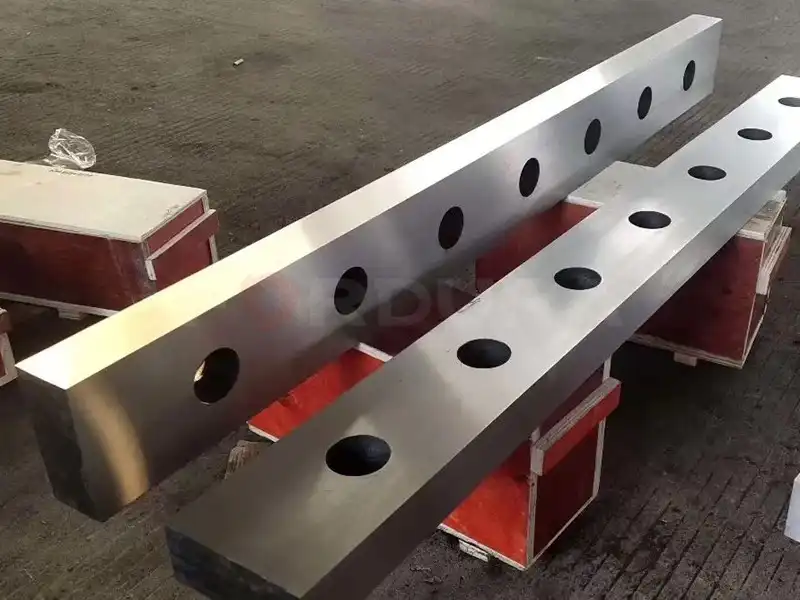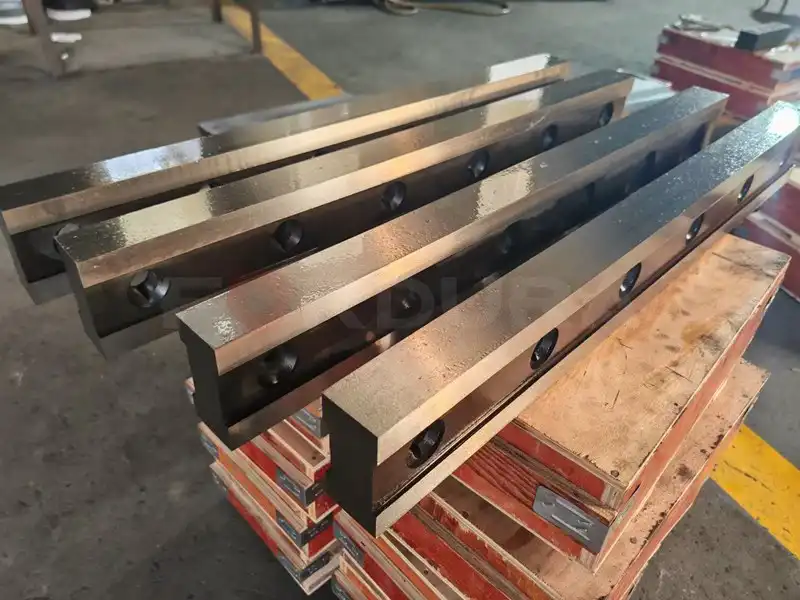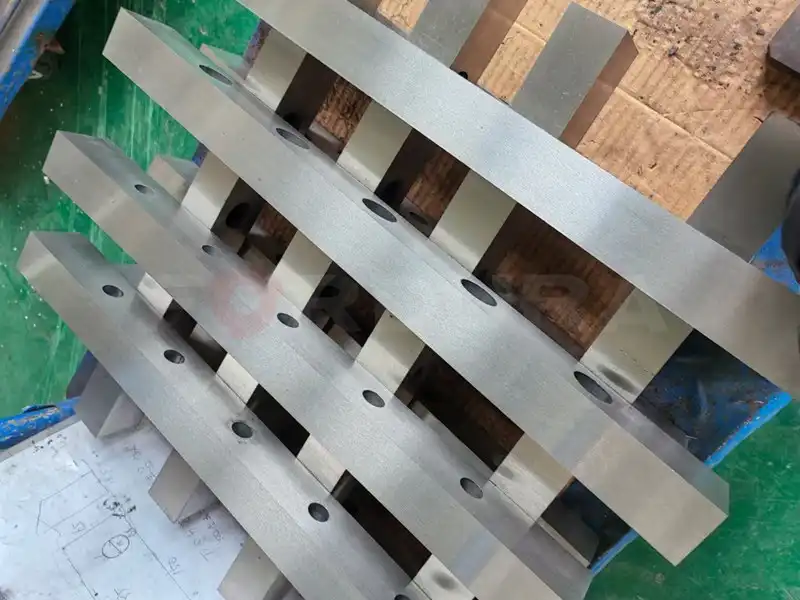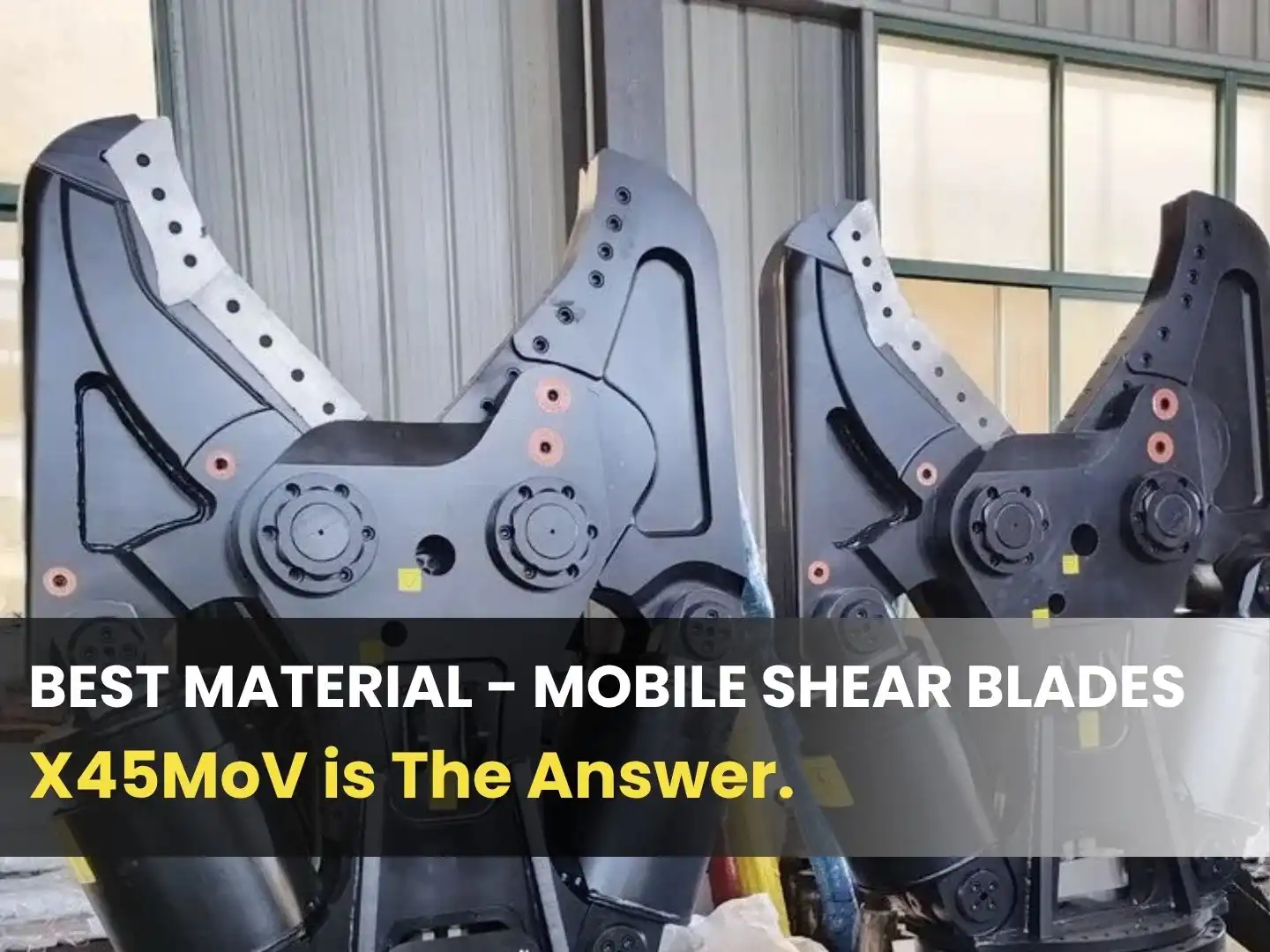
Choosing the best material for mobile shear blades is not about chasing the highest hardness number or assuming the most expensive grade is always the right answer. The real question is whether the material can stay stable under the actual conditions of the job: shock loading, scrap contamination, moisture exposure, corrosion risk, and irregular feed.
In severe-duty mobile shear applications, X45MoV is often one of the strongest material choices because it offers a more reliable balance of toughness, corrosion resistance, and edge stability. But that does not mean it is the best answer for every machine or every job. The right choice still depends on working conditions, failure pattern, and the real cost of downtime.
Why the “Best” Material Depends on Real Working Conditions
Many blade-buying mistakes begin with an incomplete comparison. A material may look impressive on a specification sheet because it offers high hardness or promising wear resistance. But mobile shear blades do not fail only from gradual wear. They fail when multiple stresses act together.
A mobile shear blade must often survive repeated shock loading, high-pressure cutting contact, abrasive scrap contamination, thermal cycling, and surface deterioration caused by wet or corrosive environments. When these stresses overlap, a blade material that is only hard can quickly become a liability. The edge may wear slowly, but it can chip under impact. Once the edge chips, cutting pressure becomes less even, localized stress rises, and crack initiation becomes more likely. In heavy scrap work, this chain reaction is often what turns a seemingly acceptable blade into an expensive maintenance problem.
That is why experienced operators do not define the best material as the hardest material. They define it as the material that provides the most reliable balance between wear resistance, toughness, edge retention, and structural stability under actual service conditions.
A Simple Material Path Before Choosing X45MoV
Not every mobile shear application needs a premium severe-duty steel. In milder and more stable working conditions, a standard material may still deliver acceptable economics. In mid-level applications, some operators may benefit more from improving heat treatment consistency, blade geometry, or material matching before moving to a top-tier upgrade.
X45MoV becomes much more relevant when the application combines several high-risk conditions at the same time: moisture, corrosion exposure, impact-heavy scrap, unstable loading, contaminated feed, and costly downtime. In other words, X45MoV is usually strongest not because it is “the hardest,” but because it performs better when several blade-killing stresses overlap.
Why X45MoV Stands Out in Mobile Shear Service
X45MoV stands out because it is built for balance rather than one-dimensional performance. Compared with standard X45-type materials, X45MoV is more attractive when the blade must work in harsher, wetter, more impact-intensive environments where ordinary materials can reach their practical limits too quickly.
One of its key advantages is stronger resistance to corrosion-related degradation. In mobile shear operations, corrosion is not simply a cosmetic problem. In ship dismantling yards, coastal scrap facilities, wet processing environments, and heavily contaminated work areas, the blade surface is continuously exposed to moisture, oxidation, and aggressive debris. Once the blade surface begins to degrade, the cutting edge can lose consistency, small defects can develop faster, and overall blade reliability can decline well before complete wear-out occurs.
X45MoV also benefits from alloy design that supports a stronger overall performance profile under demanding service conditions. The material is better suited to maintaining a more useful balance between hardness and toughness after heat treatment, which is critical in heavy-duty shear work. In practical use, that means the blade is better able to resist edge chipping, reduce premature cracking risk, and remain stable under repeated impact cycles. This does not mean the material is indestructible. It means it performs more reliably when the operating environment is hostile and the cost of failure is high.
Why Toughness Matters More Than Hardness Alone
In severe mobile shear work, toughness is often the hidden factor behind long blade life. Hardness helps resist wear, but toughness determines whether the blade can absorb shock without losing edge integrity. When cutting mixed or contaminated scrap, the blade is frequently exposed to irregular forces rather than smooth, repeatable loading. This is where brittle performance becomes dangerous.
A blade material with insufficient toughness may still appear acceptable during early use. However, under repeated impact, small edge fractures can begin to form. These small failures often go unnoticed at first, but they change cutting behavior immediately. The blade no longer distributes force evenly, heat concentration increases at damaged points, and further edge loss accelerates. In many cases, what looks like “fast wear” is actually progressive micro-chipping followed by instability.
X45MoV is valued because it helps reduce this risk. Its performance advantage is not simply longer wear life on paper. Its real advantage is more stable behavior under combined wear and impact conditions, which is exactly the environment where many mobile shear blades struggle
Where X45MoV Creates the Most Value
Not every machine requires a premium material upgrade. In lighter and drier applications, a standard material may still be a practical choice. Good engineering is not about recommending the most expensive material in every case. It is about matching the blade material to the failure pattern of the job.
X45MoV creates the most value in applications where blade failure is accelerated by both environmental stress and mechanical shock. This includes:
- Ship dismantling, where salt, rust, moisture, and heavy plate cutting combine into one of the most punishing blade environments
- Coastal scrap yards, where humid air and corrosive conditions attack exposed blade surfaces over time
- Demolition recycling, where mixed feed and unpredictable loading raise chipping and cracking risk
- Heavy scrap processing, where throughput pressure makes downtime and emergency blade changes expensive
- Contaminated scrap streams, where foreign materials and irregular contact conditions make edge stability more difficult to maintain
In these scenarios, the benefit of X45MoV is cumulative. Better corrosion resistance helps protect the blade surface. Better toughness helps reduce chipping risk. Better structural stability helps maintain more consistent cutting behavior over longer operating cycles. The value is not in one isolated property. It is in how these properties work together when the cutting job becomes more difficult.
When X45MoV May Be More Than You Need
If the working environment is dry, the scrap stream is relatively consistent, impact severity is moderate, and blade changes do not create major downtime cost, a lower-spec material may still be the more rational choice. Over-specification is also a form of waste.
That is why X45MoV should be evaluated as a severe-duty solution, not as an automatic default. The strongest material decision is not the one with the highest specification on paper. It is the one that matches the real failure pattern of the job with the least wasted cost.
X45MoV vs Standard X45: What Changes in Real Operations
A practical comparison is more useful than a theoretical one. The question is not whether standard X45 is “bad.” In many applications, it is a workable and cost-effective option. The real question is what happens when the machine is pushed into harsher conditions.
| Performance Factor | Standard X45 | X45MoV |
|---|---|---|
| Corrosion resistance | Basic | Higher |
| Suitability for wet environments | Limited | Better suited |
| Edge stability under impact | Good in moderate duty | Stronger in severe duty |
| Resistance to chipping | Moderate | Better |
| Reliability in contaminated scrap | Acceptable | More stable |
| Service life in harsh conditions | Moderate | Higher potential |
| Downtime reduction value | Limited | Stronger |
| Best fit | Standard-duty use | Severe-duty use |
The most important difference is not simply “longer life.” It is lower failure risk under difficult conditions. A blade that lasts somewhat longer is helpful. A blade that reduces unplanned stops, edge failure, and unstable cutting behavior is much more valuable.
When Blade Material Is the Real Problem
Many operations replace blades repeatedly without first identifying whether the real problem is blade material mismatch. The table below helps buyers and operators evaluate whether an upgrade to X45MoV should be considered.
| Symptom | Likely Material-Related Cause | Recommended Action |
|---|---|---|
| Frequent edge chipping | Toughness is insufficient for shock loading | Review impact severity and consider upgrading to X45MoV |
| Blade life drops sharply in wet yards | Corrosion and surface degradation accelerate failure | Use a material with stronger corrosion resistance |
| Cracks appear before expected wear-out | Material balance is too brittle for the application | Reassess hardness-toughness balance and heat-treatment suitability |
| Blade performance changes from batch to batch | Feed variability is exposing material limitations | Move to a more stable severe-duty material |
| Too many emergency blade changes | Failure mode is not only wear, but instability | Evaluate total operating cost, not only purchase price |
This kind of diagnosis is important because many blade problems are misclassified. The blade is blamed for “wearing out too fast,” when the real issue is that the material is not stable enough for the combination of impact, corrosion, and contamination in the application.
Quick Buyer Checklist
Choose X45MoV when most of the following conditions are true:
- The machine operates in wet, humid, coastal, or corrosion-prone environments
- Edge chipping is more common than smooth wear
- Blade failure causes costly downtime
- Scrap feed is irregular, mixed, or impact-heavy
- Standard materials show unstable life across different jobs
- Reliability matters as much as unit price
- The application involves ship dismantling, demolition, or severe-duty scrap cutting
If only one or two of these conditions apply, a standard material may still be sufficient. If most of them apply, X45MoV is usually the stronger long-term choice.
How Buyers Should Evaluate Blade Material
Professional blade buying should begin with operating cost, not piece price. A lower-priced blade can look attractive in procurement, but if it fails early, chips under impact, or must be replaced more frequently, the actual cost per ton processed can be much higher.
This is especially true in high-throughput mobile shear operations, where each blade change affects labor, machine uptime, scheduling, and sometimes downstream productivity. The buyer who only compares purchase price often saves money once and loses it repeatedly afterward. The better approach is to evaluate blade material in terms of:
- blade life stability
- downtime risk
- resistance to chipping and cracking
- performance consistency in wet or severe conditions
- total cost per operating cycle
From this perspective, X45MoV often justifies its position. In the right application, it is not simply a premium blade material. It is a more reliable production decision.
Why Material Recommendation Should Start with Service Conditions
Blade material should never be evaluated in isolation. The right choice depends on what the blade is cutting, how the machine is loaded, how unstable the impact is, how much moisture is present, and how expensive downtime becomes when the blade fails early.
In severe-duty mobile shear work, repeated chipping, unstable service life, corrosion-related deterioration, and early cracking usually point to a material mismatch rather than a simple replacement cycle problem. In those cases, the better answer is not always to change blades more often. It is to match the material more precisely to the real service condition.
For operators dealing with ship dismantling, coastal humidity, contaminated scrap, or heavy impact variation, X45MoV is often worth evaluating because it addresses several failure risks at the same time instead of only improving one isolated property.