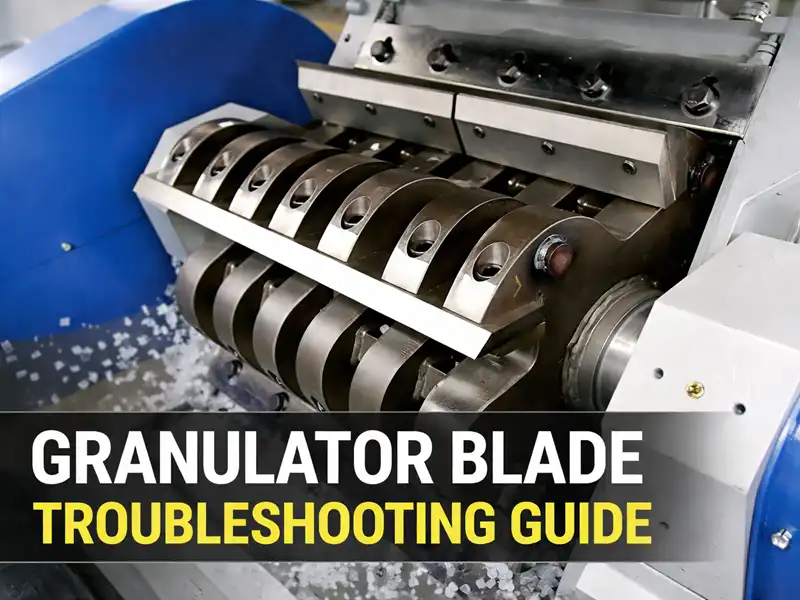
When granulator performance begins to decline, many operators immediately blame the machine, the motor, or the feedstock. In practice, the cutting system is often the first place where the problem starts to develop. Granulator blades do not usually fail in one dramatic moment. They fail progressively, and the machine reveals that decline through a series of operational symptoms long before a complete breakdown occurs. Rising amperage, unstable temperature, poor particle consistency, excessive fines, noisy cutting, and reduced throughput are not isolated problems. They are usually connected signs that the blade system is no longer working as an efficient shearing interface.
This is why granulator blade troubleshooting should never be treated as a superficial maintenance task. From a manufacturer’s perspective, the blade edge, knife geometry, material grade, hardness balance, mounting condition, and knife clearance all influence not only cut quality, but also motor load, rotor stability, screen throughput, downstream material quality, and total operating cost. A granulator may continue to run even when the blades are already performing badly, but “still running” is not the same as “running efficiently.” In many plants, that distinction is where hidden production loss begins.
Early warning signs usually include increased electrical load, overheating, uneven particle size, and abnormally fast wear. These symptoms are often linked to dull blades, incorrect spacing, overfeeding, poor blade material choice, or contaminated feedstock. In real industrial operation, each one needs to be diagnosed systematically if the goal is not just to restore function, but to restore cutting efficiency, predictable output quality, and stable blade life.
A useful troubleshooting process does not treat these symptoms separately. It reads them together as part of one cutting-system pattern.
Quick Diagnosis: What the Symptom Usually Means
Before removing the knives, it helps to connect the visible symptom to the most likely source of instability in the cutting system.
- Rising amperage with no major material change usually points to increasing cutting resistance caused by blade dullness, friction, or incorrect knife clearance.
- Abnormal heat usually suggests that more energy is being lost to rubbing, dragging, or unstable cutting instead of clean shearing.
- Inconsistent particle size, stringy flakes, or excessive fines often indicate that the cutting action is shifting away from controlled shearing toward tearing or impact fragmentation.
- Fast wear without a clear setup problem often means the blade material, heat treatment, or contamination profile should be reviewed more carefully.
- Repeated performance drop shortly after regrinding often suggests that the root cause is not edge sharpness alone, but a broader issue involving clearance, mounting stability, feed consistency, or application fit.
Why Granulator Blade Problems Should Never Be Diagnosed by Edge Appearance Alone
One of the most common mistakes in blade maintenance is judging knife condition only by visual sharpness. A blade may still look acceptable to the eye and yet already be underperforming in the machine. Conversely, a blade edge may show normal wear but still deliver stable throughput if clearance, rotor condition, material flow, and feed consistency remain under control. For this reason, effective troubleshooting must begin with machine behavior, not only with what the cutting edge looks like on the bench.
In industrial granulation, the blade is part of a dynamic cutting system rather than an isolated component. The rotor knife passes the bed knife repeatedly under load, while material thickness, hardness, contamination level, feed volume, and screen restriction all influence how that edge behaves. If the knife edge becomes rounded, the machine does not simply “cut less well.” It begins to consume more power per ton, generate more friction heat, tear rather than shear, and create more stress across the rotor and bearings. As that happens, operators often compensate unconsciously by pushing feed rate, changing operating rhythm, or accepting lower output quality. By the time the blades are finally removed, the real cost has already spread far beyond the knives themselves.
A professional troubleshooting process therefore asks a more useful question: not “Are the blades blunt?” but “How is the entire cutting system behaving compared with its stable baseline?” That shift in thinking is what separates reactive maintenance from manufacturer-level process control.
The First Signs Your Granulator Blades Are No Longer Cutting Efficiently
The earliest and most valuable warning sign is usually a measurable increase in motor load. When granulator blades lose effective sharpness, the machine must apply more force to complete the same cut. This increases amperage and raises energy consumption. In serious operations, tracking amp readings after maintenance should be treated as a standard diagnostic method rather than an occasional observation.
The second major signal is abnormal heat. Heat in a granulator is not just a comfort issue or a housekeeping issue. It is evidence that more energy is being converted into friction instead of clean cutting. Excess heat may come from dull blades, poor clearance, excessive rubbing, unstable material flow, or vibration caused by inconsistent knife condition. In real production, overheating also affects polymer behavior, cut stability, screen discharge, bearing condition, and in some cases the fire risk associated with hot contaminated plastic dust.
A third warning sign is inconsistent particle output. When operators see oversize pieces, irregular flake geometry, stringy fragments, or an unusual amount of fines, the cutting action is often shifting from controlled shearing toward tearing and impact fragmentation. This is not only a quality problem. It is often the most visible symptom of a deeper instability in blade setup, knife wear balance, or rotor-bed alignment.
Root Causes of Granulator Blade Problems
1. Blade Dullness and Edge Rounding
Dull blades are the most familiar cause, but “dull” should be understood as a performance condition rather than merely a visual one. A rounded edge increases the force required to initiate a cut. In plastic applications, that can drag, smear, or partially deform the material before fracture. In harder or dirtier streams, it can accelerate micro-chipping and lead to unstable wear along the full knife length. Once this happens, the machine no longer cuts at a consistent pinch line. The operator may hear more noise, see more temperature rise, and notice that output quality changes before the edge looks dramatically damaged.
2. Incorrect Knife Clearance or Poor Setting Consistency
Clearance is one of the most underestimated variables in granulator performance. If the gap is too large, the material is more likely to tear than shear. If the gap is too tight, the knives may rub, heat up, or wear prematurely. Even when the nominal clearance value is correct, poor consistency across the full blade length can still create uneven cutting zones. One section may cut cleanly while another drags or rubs, resulting in localized heat, uneven wear, and unstable particle size. Maintaining the same effective spacing across the knife length is central to both performance and blade life.
3. Overfeeding and Unstable Material Presentation
Excessive feed volume can cause material to float on the rotor and scrape before it is cut, which accelerates knife wear. That is an important field reality. Overfeeding does not always appear as obvious overload. In many plants, the more damaging condition is inconsistent feeding: slugs of material, bulky pieces, poorly controlled conveyor discharge, or operators’ hand-loading material in bursts. This creates alternating empty and overloaded cutting conditions, which is destructive for both blade edge stability and machine smoothness. A granulator performs best when the knives engage material in a controlled and repeatable manner. Stable feed is not just a throughput issue; it is a blade preservation strategy.
4. Wrong Blade Steel or Inappropriate Heat Treatment
Not all granulator blade failures are maintenance failures. Some are selection failures. A blade that performs well in clean rigid plastic may perform badly in abrasive regrind, dirty post-consumer material, fiber-filled compounds, or applications with hidden metal contamination. Surface enhancement methods such as tungsten carbide coating may extend service life in some operating conditions, but the real issue is application matching. Blade steel, hardness range, toughness reserve, and heat treatment stability must be selected around the actual wear mode. If the application punishes the edge with abrasion, impact, contamination, and thermal cycling, then simply choosing a “harder blade” is often the wrong answer. The better answer is the right compromise between wear resistance and fracture resistance.
5. Contaminated Feedstock and Hidden Abrasive Wear
Dirt, mixed materials, and inadequate cleaning can severely reduce blade life. This is especially important in recycling operations where the most damaging wear is often not caused by the target material itself, but by what comes attached to it: dust, sand, glass particles, labels, trapped metal, mineral residue, and other abrasive contaminants. These materials can destroy an edge long before operators realize the wear pattern is abnormal. When troubleshooting frequent regrinds or short blade life, the feedstock contamination profile should always be reviewed with the same seriousness as blade metallurgy.
A Step-by-Step Granulator Blade Troubleshooting Process
A reliable troubleshooting process should follow a fixed sequence rather than relying on visual judgment alone.
Step 1: Establish the Stable Baseline
Start by defining what normal machine behavior looks like. Record the typical amperage range, throughput, particle size distribution, blade life interval, and operating temperature under stable conditions. Without that baseline, maintenance decisions become subjective, and subjective judgment is expensive.
Step 2: Compare Current Machine Behavior Against the Baseline
Review what has changed. Has motor load increased even though the material stream is the same? Has throughput dropped while amperage rises? Are operators clearing the screen more often? Has the percentage of fines, oversized pieces, or stringy output increased? Has the rotor become noisier or less stable? Blade problems usually reveal themselves through a pattern of changes, not through one symptom alone.
Step 3: Perform a Mechanical Inspection
Remove and inspect the knives for edge rounding, micro-chipping, uneven wear, heat discoloration, rubbing marks, or improper mounting. Then inspect knife seats, clamping surfaces, bolts, rotor condition, and bed knife alignment. Many apparent blade failures actually begin with mounting instability or uneven setup.
Step 4: Verify Knife Clearance Across the Full Length
Check the knife gap across the entire blade length rather than at only one point. A clearance setting that is acceptable at one end but incorrect at the other is already a performance problem. Consistency matters as much as nominal value.
Step 5: Review the Operating Process
Finally, review feed consistency, upstream cleaning, contamination level, material hardness variation, moisture, bulk density, and recent process changes. A plant may install a better blade and still see poor life if the actual operating conditions have become harsher than before.
Only after these five steps should the decision be made whether to regrind, replace, redesign, or upgrade the blade material.
Inspection Checklist Before Failure Occurs
Before a blade reaches obvious failure, maintenance teams should check for these early indicators:
– Rising amperage under otherwise stable material conditions
– Abnormal heat around the cutting chamber
– More fines, oversize pieces, or stringy output than normal
– Uneven wear across the knife length
– Micro-chipping or edge rounding after a shorter-than-normal run time
– Rubbing marks caused by poor clearance consistency
– Loose mounting, unstable clamping, or wear concentrated in one section of the blade
– More frequent screen blockage or unstable discharge behavior
– A noticeable drop in throughput without a corresponding process change
If several of these signs appear together, the problem should be treated as a system-level cutting issue rather than as a simple sharpening schedule issue.
When Regrinding Is Enough—and When Replacement Is the Better Decision
Not every blade problem requires immediate replacement. In many cases, regrinding is still the most economical option—but only when the blade remains mechanically sound.
Regrinding is usually enough when:
- wear is mainly normal edge rounding
- the blade remains dimensionally stable
- there is enough material left to restore the edge without damaging geometry
- the mounting surface is still reliable
- there are no recurring cracks, severe chips, or heat-related distortion
Replacement is usually the better decision when:
- chipping is severe or repeatedly returns after service
- the blade shows distortion, overheating damage, or unstable geometry
- mounting surfaces are no longer reliable
- excessive material loss has already changed blade behavior
- the knife can be sharpened cosmetically but no longer restores stable cutting performance
This is where many maintenance teams lose money. They keep regrinding blades because the sharpening invoice looks small, while the real cost continues to rise through lost throughput, higher power draw, unstable product quality, more frequent changeovers, and greater risk of unplanned stoppage.
From a manufacturer’s point of view, the correct decision is not the cheaper immediate action. It is the action that returns the cutting system to stable, repeatable, and cost-efficient production.
How to Extend Granulator Blade Life in Real Production Conditions
Longer blade life does not come from one improvement alone. It comes from controlling the full relationship between blade design, material selection, operating method, and feed condition.
Plants that achieve consistently good knife life usually do five things well:
- They maintain a stable feed rate so the knives engage material in a controlled and repeatable way.
- They monitor amperage and temperature instead of waiting for visible failure.
- They set knife clearance carefully and keep that setting consistent across the full blade length.
- They match blade steel to the real wear mechanism instead of buying only on price or hardness claims.
- They reduce contamination before material reaches the cutting chamber.
There is also an important strategic point here: the best blade is not always the blade with the highest hardness or the most aggressive wear claim. In many granulator applications, the best blade is the one that keeps an efficient edge long enough to maintain predictable throughput without becoming brittle, unstable, or difficult to service.
Reliability in production matters more than marketing language on paper.