Wood chipper blade replacement should never be treated as a simple parts swap. In real operation, it is a safety procedure, a precision maintenance task, and a performance decision all at once.
Many articles explain blade changes at a basic level. That is helpful, but in industrial and commercial chipping work, the real question is not only how to replace wood chipper blades safely. The bigger question is whether the replacement is being done in a way that protects the operator, preserves rotor integrity, and restores cutting efficiency rather than creating new vibration, inconsistent chip size, or premature hardware failure.
From a manufacturer’s point of view, a successful wood chipper blade replacement depends on three things:
- The machine must be made fully safe before service begins
- The blade seat and related wear parts must be inspected, not ignored
- The new blades must be installed with correct fit, alignment, and fastening discipline
If any of those three steps are handled poorly, the chipper may run—but it will not run correctly.
Why Blade Replacement Is More Than a Maintenance Routine
During servicing and maintenance, OSHA’s lockout/tagout standard applies where unexpected startup, energization, or release of stored energy could injure workers. NIOSH also warns that failure to control hazardous energy during machine maintenance can cause severe injury or death.
That matters because a wood chipper is not a harmless stationary assembly once the engine is off. Rotating components, mechanical inertia, spring-loaded or hydraulic systems, and improperly secured access covers can all create residual risk. NIOSH has documented fatal incidents involving chipper hoods or guards being opened or closed improperly while knives were still rotating.
So the first rule is simple: blade replacement begins with energy isolation, not with a wrench.
Signs Your Wood Chipper Blades Need Replacement
Dull chipper blades do not always look dramatic. In many cases, performance degrades before operators notice obvious edge damage. The reference page itself appears to emphasize “dull blades” as the starting point, which is the correct direction.
In real production, the common warning signs are more specific:
1. Higher feed resistance
If the machine begins pulling material less smoothly, the cutting edge may be losing bite and requiring more force to shear fibers cleanly.
2. Declining chip quality
When blades wear, chip size often becomes less consistent. Instead of clean cutting, the machine starts tearing, crushing, or bruising wood fibers.
3. Rising fuel or power demand
A worn edge forces the machine to work harder for the same throughput. On high-volume operations, that translates directly into higher operating cost.
4. More vibration or impact loading
If the edge is chipped, rounded, or unevenly worn, cutting loads become less stable. That instability can transfer into the rotor, bearings, and mounting hardware.
5. Premature stress on the anvil and fasteners
A blade does not work alone. Once the edge geometry is no longer correct, the relationship between blade and anvil changes, which can accelerate wear across the cutting system.
A professional replacement decision should therefore be based on performance, edge condition, and machine behavior together—not on appearance alone.
What to Prepare Before You Change Chipper Blades
Before removing a single bolt, prepare the job like a controlled maintenance task.
Follow formal lockout/tagout procedures
OSHA states that servicing equipment exposed to unexpected startup or hazardous energy requires control procedures that prevent energization while maintenance is underway.
Verify zero-energy condition
Do not assume “off” means safe. Stored energy must be released, blocked, or otherwise neutralized before work starts. OSHA’s guidance and training materials explicitly stress verifying shutdown and blocking or draining stored energy.
Wear the right PPE
OSHA guidance on PPE highlights hazards from flying chips, dust, and debris, while wood-processing safety materials emphasize eye, face, hearing, foot, and hand protection.
Prepare the right replacement components
This is where many teams cut corners. Do not prepare only the new knives. Also check whether you need:
- new blade bolts
- washers or locking hardware
- anvil adjustment parts
- shims if specified by the machine design
- anti-seize or approved thread treatment if required by OEM practice
- cleaning tools for the blade seat and clamping area
A blade replacement stops being “cheap” the moment a reused damaged bolt, contaminated contact surface, or worn clamping seat causes movement in service.
Step-by-Step Wood Chipper Blade Replacement Procedure
The exact sequence depends on chipper design, but the manufacturer-level logic should look like this.
1. Isolate the machine fully
Shut down the unit, remove the ignition source or disconnect electrical power, apply lockout/tagout, and confirm the rotor cannot move unexpectedly.
2. Wait for complete stop and safe access
Never open service access on assumption. As NIOSH incident reporting makes clear, rotating components and improperly handled guards can be deadly.
3. Open the housing and inspect before disassembly
Before removing blades, inspect:
- blade edge condition
- anvil condition
- bolt heads and seating surfaces
- evidence of blade movement
- wear marks on the rotor pocket or mounting face
- resin, dirt, rust, or compression marks on the clamping area
This inspection often tells you why the blade wore the way it did. That is valuable information. Replacing blades without understanding the wear pattern is how repeat failures happen.
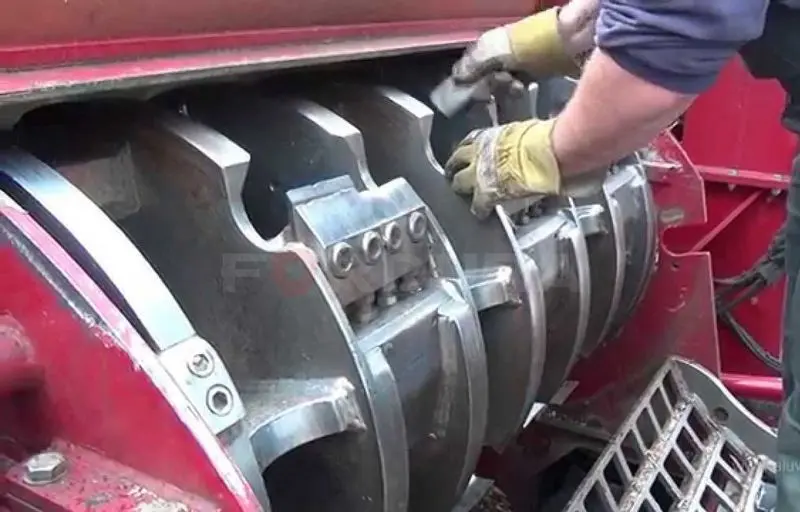
4. Remove blades carefully and in sequence
Support the blade during removal. Chipper knives are heavy, sharp, and often awkward to handle. Remove hardware methodically and keep parts organized by position if wear comparison is needed.
5. Clean the mounting surfaces completely
This step is routinely underestimated. Even slight debris, burrs, embedded chips, or corrosion under the blade can affect seating. Poor seating causes uneven clamping force, edge misalignment, and unstable cutting.
6. Inspect the anvil before installing new blades
Many maintenance teams replace the knife and ignore the stationary counterpart. That is a mistake. If the anvil is rounded, chipped, or out of setting, the new blade will not deliver proper cutting action even if the blade itself is excellent.
7. Check the replacement blade dimensions and orientation
Confirm length, width, thickness, hole pattern, bevel direction, and edge orientation. A blade that is “close enough” dimensionally can still install poorly or alter cutting clearance.
8. Install with disciplined fastening practice
Seat the blade properly, ensure full contact on the mounting face, and tighten hardware in a controlled sequence. Follow the chipper OEM torque specification where available. Uneven tightening can distort seating and shorten blade life.
9. Verify blade-to-anvil relationship
Correct edge condition alone does not guarantee clean cutting. Clearance and alignment between knife and anvil determine how efficiently material is severed.
10. Rotate and inspect before restart
Before startup, manually verify nothing interferes, all hardware is secure, and all guards and covers are properly closed and re-secured.
11. Restart gradually and observe early behavior
The first minutes after replacement matter. Listen for abnormal impact, vibration, or inconsistent feeding. A correct installation usually sounds smoother and cuts more cleanly almost immediately.
Common Mistakes That Reduce Blade Life
The most common field mistakes are not dramatic—they are procedural:
- replacing the blade but not inspecting the anvil
- reusing questionable bolts
- installing onto dirty or dented contact surfaces
- mixing blades with inconsistent dimensions or wear states
- ignoring rotor pocket damage
- overtightening or uneven tightening without controlled sequence
- buying replacement blades based only on price, not material and heat treatment consistency
These are exactly the details that separate a successful blade replacement from a temporary restart.
Should You Replace the Anvil, Bolts, or Hardware at the Same Time?
Often, yes.
A new blade installed against a badly worn anvil is like mounting a new cutting tool against a damaged reference surface. The machine may run, but cutting efficiency and edge life will not be what they should be.
Likewise, damaged or fatigued fasteners are a false economy. In blade systems exposed to repeated shock loading, clamping reliability matters just as much as blade hardness.
From a manufacturer’s perspective, buyers should think in terms of a cutting set, not just an individual blade.
How to Choose Better Replacement Wood Chipper Blades
Not all replacement chipper knives are equal, even when the drawing size matches.
What really matters is:
- steel grade suitability for the application
- heat-treatment consistency through the working section
- dimensional accuracy of thickness, hole position, and flatness
- edge preparation quality
- reliability of fit on the intended chipper model
- technical support when wear patterns suggest the current blade design is not optimal
This is where many aftermarket blade purchases disappoint. The blade “fits,” but it does not hold edge the way it should, or it creates secondary issues because tolerances, seating, or hardness distribution are inconsistent.
For serious operators, the goal is not simply to buy replacement wood chipper blades. The goal is to buy blades that lower cost per processed ton.
Why Buyers Source Wood Chipper Blades Directly from the Manufacturer
When you buy directly from an experienced manufacturer, you gain more than a part number.
You gain access to:
- application-based material recommendations
- engineering review of wear patterns
- control over dimensional tolerance and heat treatment
- OEM and replacement options
- a more reliable basis for repeat purchasing
That is especially important when the machine handles abrasive feedstock, contaminated wood, variable moisture content, or high-duty-cycle operation. In those environments, blade life is rarely determined by edge geometry alone. It is a system issue—and manufacturers are in the best position to diagnose system issues.
Final Thoughts
The safest and most effective wood chipper blade replacement procedure is not the fastest one. It is the one that restores cutting performance without compromising operator safety, rotor condition, or long-term machine stability.
The reference article covers the basic idea of changing chipper knives safely, but for Fordura, the stronger position is to go deeper: replacement timing, lockout discipline, anvil inspection, mounting integrity, and blade selection based on operating reality—not guesswork.
Where to Buy Reliable Replacement Wood Chipper Blades
When it comes to replacing wood chipper blades, many operators assume the only option is purchasing directly from the original equipment manufacturer. In reality, professional arborists, recycling companies, and biomass processors often work with specialized blade manufacturers that produce OEM-compatible replacement chipper knives with the same dimensional accuracy and performance standards.
Choosing the right supplier goes beyond simply finding a compatible blade size. A reliable manufacturer should offer consistent steel quality, stable heat treatment, and precise machining tolerances. Just as importantly, they must understand real operating conditions—such as abrasive materials, contaminated wood waste, and high-throughput processing—so that blade life and cutting performance remain predictable.
Fordura specializes in manufacturing high-performance replacement wood chipper blades for industrial and commercial chipping equipment. Our blades are engineered to match OEM specifications while providing consistent hardness, accurate dimensions, and dependable supply for professional users worldwide. By working directly with a manufacturer like Fordura, customers gain not only cost-effective replacement blades, but also engineering support that helps extend blade life, reduce downtime, and maintain stable cutting performance.
Why Professionals Choose Fordura for Replacement Wood Chipper Blades
Fordura manufactures high-performance replacement wood chipper blades and knives designed to meet or exceed OEM specifications. Every blade is produced using carefully selected tool steels, precision CNC machining, and controlled heat treatment processes to ensure consistent hardness, dimensional accuracy, and long-term durability.
Unlike many aftermarket suppliers, Fordura approaches chipper blades from a manufacturer and engineering perspective. Our team works with equipment manufacturers, recycling companies, and wood processing facilities worldwide, allowing us to understand the real conditions that cause blade wear—from abrasive bark contamination to high-volume biomass processing.
By working directly with Fordura, customers gain more than replacement parts. They gain a technical partner capable of recommending blade materials, optimizing edge geometry, and improving blade life to reduce downtime and overall operating cost.
Request a Quote for Replacement Wood Chipper Blades
Looking for a reliable supplier of replacement wood chipper blades or OEM-compatible chipper knives?
Fordura provides engineered blade solutions for a wide range of wood chippers used in arboriculture, forestry, recycling, and biomass processing. Whether you need replacement knives for an existing machine or a custom blade design for specialized applications, our engineering team can assist.
Send us your blade drawings, dimensions, machine model, or worn blade samples, and our engineers will recommend the most suitable blade material and configuration for your operation.
👉 Contact Fordura today to receive a technical evaluation and quotation for wood chipper blades.