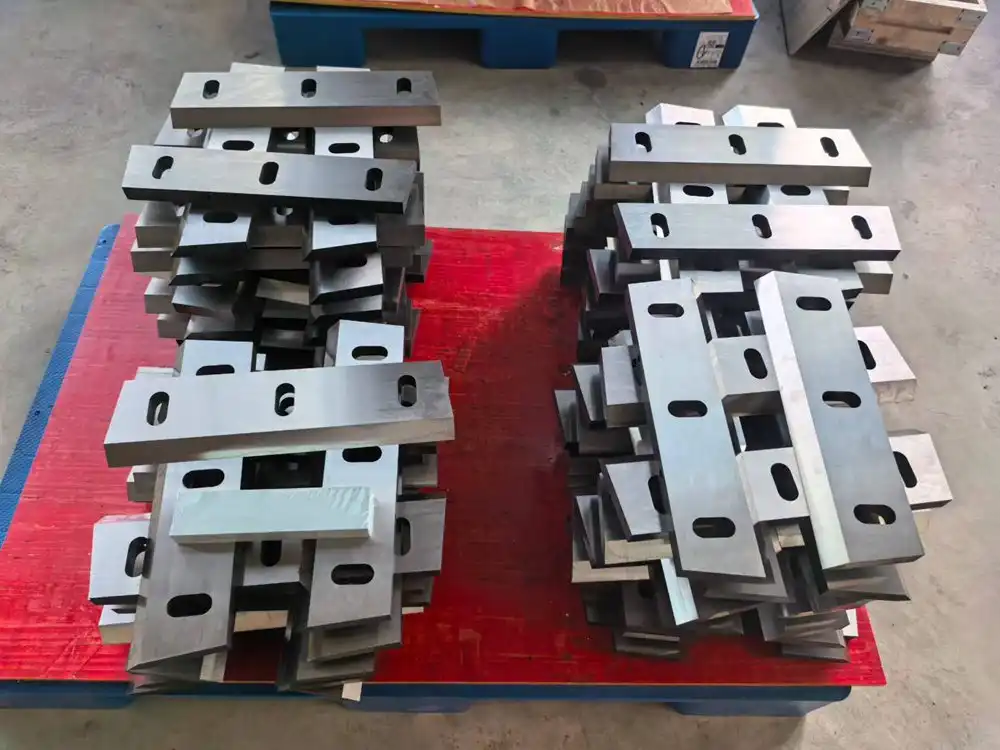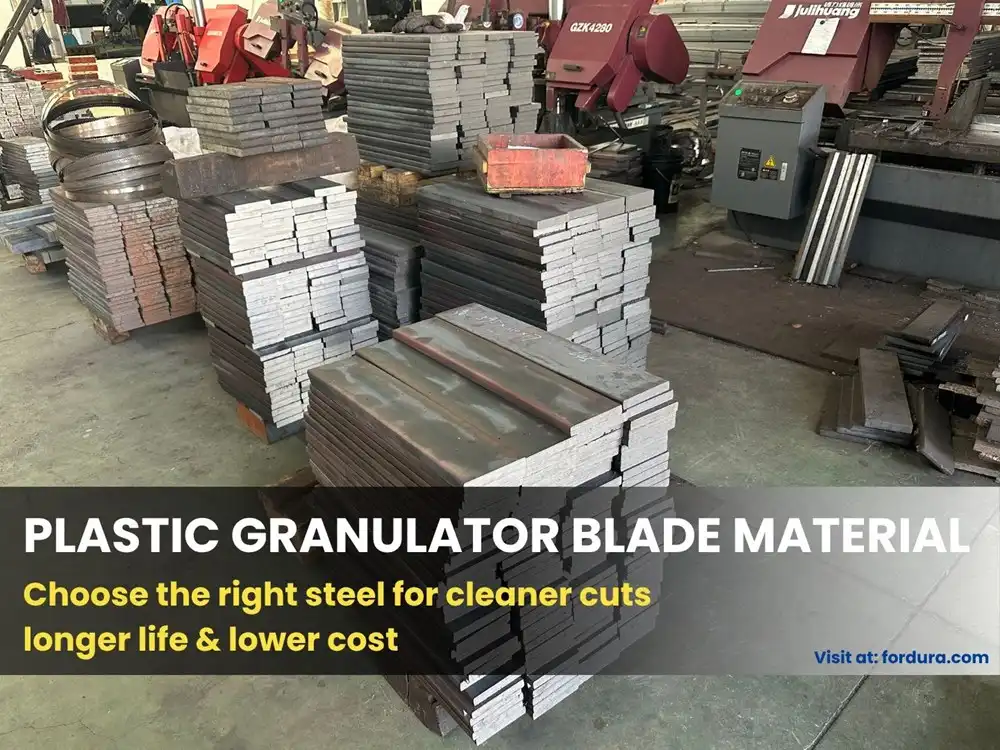
Choosing the right plastic granulator blade material is one of the most important decisions in granulator maintenance, yet it is also one of the most misunderstood. Many buyers assume that the hardest blade must be the best blade, while many operators believe that higher material cost automatically means longer service life. In real production, neither assumption is reliable. Blade failure is usually not caused by a single factor. It is the result of a mismatch between blade material, feedstock cleanliness, plastic toughness, impact load, sharpening practice, and machine condition. This is why two plants running what appears to be the same granulator can report completely different blade life from the same steel grade.
From Fordura’s manufacturing perspective, the first step in blade selection is not asking which steel is the most expensive or which grade has the highest advertised hardness. The first step is understanding the real cutting environment. Are you processing clean rigid regrind, film scrap, injection molding lumps, PET bottles, woven bags, engineering plastics, or mixed post-consumer waste? Is the feedstock stable, or does it sometimes contain metal, stone, glass fiber, or other unexpected contamination? Are you trying to maximize wear life, reduce chipping risk, lower purchase cost, or reduce total cost per ton processed? Once those questions are clear, material selection becomes far more logical.
Why Blade Material Selection Often Goes Wrong
In many recycling plants, blade selection is still made with incomplete information. One buyer chooses a premium grade because the previous blade wore too fast. Another chooses a softer and cheaper grade because the previous blade chipped badly. Both decisions can be correct in one situation and completely wrong in another. Wear and chipping are not the same failure mode, and they should not be solved with the same material strategy.
A blade that becomes rounded, dull, and slow is usually telling you that wear resistance is insufficient for the actual job. A blade that shows micro-chipping, serrated edges, or local edge breakout is usually telling you that toughness is insufficient, or that contamination and shock load are higher than expected. In other words, excessive wear points toward a hardness and abrasion problem, while chipping points toward an impact and brittleness problem. The correct material decision begins when you read those symptoms accurately instead of replacing one wrong steel with another.
💡 Technical Tip: Do not judge blade material only by service life in days. A blade that lasts longer but produces more dust, higher amperage, and poorer particle consistency may increase total processing cost instead of reducing it.
A Quick Comparison of Common Plastic Granulator Blade Materials
| Material | Typical Positioning | Main Strength | Main Limitation | Best-Fit Working Condition |
|---|---|---|---|---|
| 65Mn | Entry-level economy grade | Low cost, decent toughness | Limited wear resistance | Low-output, soft plastic, budget-sensitive applications |
| 55SiCr | Entry-level upgraded spring steel route | Better elasticity and toughness than basic carbon steel routes | Still not ideal for long abrasive duty | New machine supply, light-duty or stable soft materials |
| 9CrSi | Balanced workhorse grade | Good toughness-to-wear balance | Not the longest-life option in very clean abrasive plastics | Mixed recycling, occasional contamination, general-purpose granulating |
| SKD11 | Premium wear-resistant grade | Strong wear resistance and edge retention | Less forgiving under shock than tougher grades | Clean hard plastics, stable feed, higher wear demand |
| D2 | Premium wear-resistant grade in the same general family as SKD11-type selections | High wear resistance, stable cutting edge | Can chip if impact risk is underestimated | Clean rigid plastics, engineering plastics, continuous production |
| DC53 | Premium balanced upgrade path | High hardness with better toughness balance | Higher purchase cost | High-output lines that need both wear life and edge stability |
| HSS / carbide-based special options | Special-case solution | Very high hardness and wear capability in the right application | Narrow tolerance for contamination and impact | Extremely clean and tightly controlled feed conditions |
Entry-Level Materials: 65Mn and 55SiCr
65Mn and 55SiCr sit at the low-to-mid end of the cost curve, and for that reason they are still widely used in OEM supply and budget-driven replacement projects. These materials are not “wrong” choices by default. They become wrong only when plants expect them to perform like premium cold-work die steels in difficult recycling conditions. In soft, clean, low-volume applications, these grades can still be practical. They offer acceptable toughness, relatively low procurement cost, and a reasonable entry point when the machine is not running under heavy abrasive load.
The limitation is that their cutting edges tend to lose sharpness faster in continuous production. Once the edge rounds off, the machine often begins to show slower discharge, increased dust, rising power draw, and less stable particle size. That does not necessarily mean the blade has catastrophically failed, but it does mean cutting efficiency is declining. For plants running longer shifts or processing harder and more abrasive plastics, these grades often create hidden cost through more frequent sharpening and shorter replacement intervals.
⚠️Warning:
A low-cost blade is not truly low cost if it increases sharpening frequency, causes unstable granule size, or forces operators to stop the line more often.
Why 9CrSi Remains a Practical Workhorse Grade
In real recycling operations, 9CrSi remains one of the most practical blade materials because it sits in the middle of the decision map. It is not the cheapest option, but it is often the most forgiving option. It is not the most wear-resistant grade available, but it offers a useful balance between hardness, toughness, and operating stability. That balance is exactly why it performs well in many day-to-day recycling plants..
Fordura engineers often recommend 9CrSi when the feedstock is not perfectly clean and when the line occasionally sees small screws, wire fragments, hard inclusions, or unstable scrap quality. In those situations, choosing a very hard blade can backfire. A premium wear-resistant steel may look attractive on paper, but once intermittent impact enters the cutting chamber, the risk of chipping rises. A slightly more forgiving grade can deliver a lower total cost because it keeps cutting without sudden edge breakout. For many buyers, that matters more than chasing the longest theoretical wear life.
This is also why 9CrSi is often the most reasonable choice for general recycling streams such as mixed rigid plastics, strapping, injection molding lumps, and daily post-industrial scrap. It is a steel grade that makes sense when the plant needs stability, not material prestige.
Premium Wear-Focused Grades: SKD11, D2, and DC53
When plants process clean, harder, more abrasive, or more demanding plastics, the material conversation changes. In these cases, higher wear resistance can create real return. SKD11 and D2 are common premium choices for this reason. They are widely used when operators want stronger edge retention, better resistance to abrasive wear, and more stable cutting performance over longer runs. In clean rigid scrap or engineering plastics, these grades often outperform entry-level materials by a clear margin.
However, it is important to choose them for the right reason. A premium steel should not be selected simply because the previous blade failed. It should be selected because the actual failure mode was abrasive wear, not impact damage. If the previous blade chipped because the material stream was contaminated, switching from a balanced grade to a harder grade may worsen the problem instead of solving it.
DC53 is often the most attractive premium option when a plant wants high wear resistance without becoming too vulnerable to edge damage. In practical terms, it is often chosen when D2/SKD11-level wear resistance is desirable, but the application still needs a stronger toughness margin. For high-output plants processing relatively stable feedstock, DC53 can be an excellent choice because it helps extend edge life while maintaining better resistance to local chipping than many buyers expect from a high-hardness material.
💡 If you are still comparing 9CrSi, SKD11, D2, and DC53 for a specific recycling application, this additional granulator blade material selection guide can help narrow the choice based on feed cleanliness, wear target, and toughness requirement.
HSS, Tungsten Carbide, and Carbide-Tipped Options: Why Terminology Matters
This is one of the most confusing areas in the market. Buyers often hear terms such as “white steel,” “tungsten steel,” and “carbide” used as if they mean the same thing. In practice, they do not. Some suppliers use “white steel” to refer to high-speed steel. Others use “tungsten steel” loosely when they are really talking about carbide-containing solutions. In purchasing conversations, that kind of language creates expensive misunderstandings.
What matters is not the nickname but the actual blade structure. Is it a solid steel blade? A high-speed steel blade? A brazed carbide-tipped design? A composite or overlay solution? These are very different products with very different failure risks. Extremely hard solutions can perform very well in highly controlled conditions, but they usually demand cleaner feedstock, tighter operating discipline, and a lower tolerance for impact contamination. Once metal fragments or shock load enter the chamber, expensive edge loss can happen very quickly.
For that reason, Fordura does not recommend special ultra-hard solutions as a default upgrade. They should be treated as application-specific tools, not universal answers. If the feedstock is not consistently clean, a more balanced steel often delivers better economics.
Read Blade Failure Before You Change Material
One of the simplest ways to improve blade selection is to stop asking only what material to buy and start asking what the used blade is already telling you. Blade failure leaves evidence. When operators and buyers learn to read that evidence, material decisions become faster and more accurate.
⚠️ Facing Performance Issues? If the machine is already showing fast wear, chipping, rising dust, unstable particle size, or abnormal cutting noise, a deeper troubleshooting review may be necessary before changing materials again. Read this granulator blade troubleshooting guide to check whether the real issue comes from blade grade, knife clearance, sharpening condition, or rotor setup.
| Symptom | What It Usually Means | Better Direction |
|---|---|---|
| Edge becomes rounded, dull, and cutting slows down | Wear resistance is too low | Move toward a higher wear-resistant grade such as SKD11, D2, or DC53 |
| More dust and fines appear | Edge retention is declining or clearance is no longer ideal | Review both material choice and knife condition |
| Local chipping or saw-tooth edge appears | Toughness is too low for actual impact load | Move toward a tougher, more forgiving grade such as 9CrSi |
| Large edge breakout happens suddenly | Contamination or shock load is higher than expected | Improve feed control and avoid over-hard material selection |
| Blade life varies greatly from batch to batch | Feedstock condition is unstable | Select for tolerance and consistency, not only hardness |
🛠️ Maintenance Note: f two consecutive blade sets fail in different ways, the problem may not be the material alone. Check knife clearance, rotor stability, mounting accuracy, sharpening quality, and feed contamination control before blaming steel grade.
A Practical Selection Matrix for Buyers and Plant Managers
For clean and stable materials, especially rigid plastics with low contamination risk, premium wear-resistant grades usually make sense. If the plant values long runs, consistent edge retention, and lower sharpening frequency, DC53, D2, or SKD11 are often the better route.
For general recycling conditions, where materials are not always clean and occasional contamination is realistic, 9CrSi is often the most economical answer. It may not be the most impressive grade in a brochure, but it often becomes the best grade in real production because it balances wear life with survivability.
For new machine supply, cost-sensitive projects, or soft low-load operation, 65Mn and 55SiCr can still be acceptable. The key is to match expectations to reality. These grades are suitable when the plant understands that lower purchase cost usually comes with shorter edge life under demanding duty.
For highly controlled, ultra-clean, and specialized lines, HSS or carbide-based options may be worth discussing. But this decision should only be made after the feed condition, contamination control, and failure risk are fully understood.
What Buyers Should Ask Before Ordering Replacement Blades
Before placing a new order, buyers should ask five practical questions. What plastic are we actually cutting? How clean is the feedstock in real production, not in theory? What is the dominant failure mode on the current blade: wear or chipping? How often are blades sharpened, and how consistent is the sharpening quality? Are we optimizing for lowest purchase price, or lowest cost per ton processed?
These questions sound simple, but they separate smart blade purchasing from repeated trial-and-error. The most expensive mistake in blade purchasing is not buying a premium grade. It is buying the wrong grade again and again because the plant never defined the real working condition.
Fordura’s View: The Best Blade Material Is the One That Fits the Job
There is no single “best” plastic granulator blade material for every recycling line. The best choice is the one that fits the feedstock, contamination level, machine setup, maintenance discipline, and production target. In some plants, that means a balanced grade like 9CrSi. In others, it means moving up to DC53 or D2 for better wear resistance. And in some low-duty cases, a basic economy grade is still the right commercial decision.
At Fordura, we do not treat material selection as a catalog exercise. We treat it as an engineering matching process. When buyers share machine model, blade drawing, feedstock type, wear photos, or failure history, our team can usually narrow the correct material route much faster and help reduce both blade replacement frequency and total operating cost.

Frequently Asked Questions
Choosing the right granulator blade material often depends on more than one variable. The questions below cover the most common concerns from plant managers, maintenance teams, and buyers comparing blade materials for different plastic processing conditions.